

Forever chemicals have been linked to preterm births, miscarriage, preeclampsia, and lower birth weights. Now, a first-of-its-kind study may offer clues as to why.
UC San Francisco Associate Professor Joshua Robinson, PhD, of the Department of Obstetrics, Gynecology and Reproductive Sciences and colleagues conducted what they believe is the first comprehensive study to examine how forever chemicals may alter proteins in donated human placental cells.
The placenta is our earliest lifeline. The roughly 9-inch-wide organ connects a fetus’ umbilical cord to the uterine lining. It weaves a new scaffolding of blood vessels through which a mother and fetus exchange oxygen and nutrients.
Robinson, whose research is supported by federal funding, the California Protection Agency’s Office of Environmental Health Hazard Assessment, the UCSF California Preterm Birth Initiative, and the UCSF-Stanford Environmental Research and Translation for Health (EaRTH) Center, tells us what they uncovered and what it might mean.
How are we exposed to forever chemicals?
Forever chemicals are also known as PFAS, or per- and polyfluoroalkyl substances. They were most famously found in products like early non-stick cookware, but they were also used in waterproof and stain-resistant fabrics, and even food wrappers. They resist breaking down, which means that some of these chemicals can linger in our environment for thousands of years.
More than 95% of pregnant women in the U.S. have detectable levels of PFAS in their blood. The compounds — some of which are carcinogenic — can persist in our bodies, including in fetal and placental tissues.
Why the placenta?
Specifically, we studied specialized placental cells called trophoblasts. These cells help the placenta attach to the uterus and reshape maternal blood vessels, so that enough blood reaches the placenta. They can also develop into another important cell that forms the barrier between mother and the fetus, allowing oxygen and nutrients to pass to the fetus while carrying away waste.
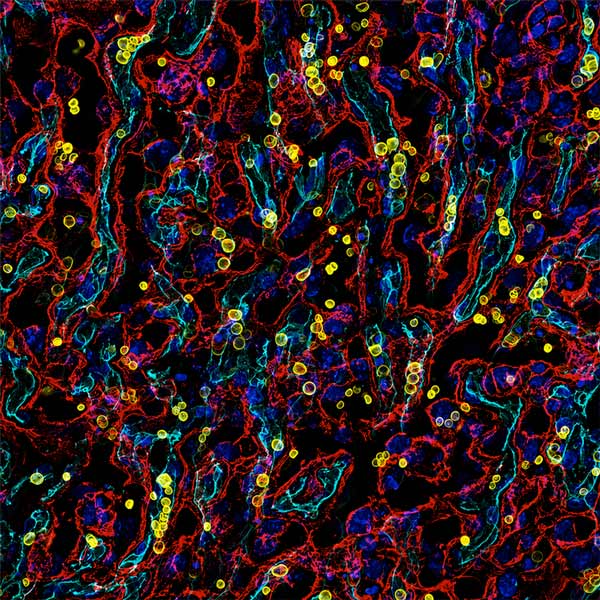
Trophoblasts, shown here in red surrounded by blue blood vessels, help establish blood flow to the placenta and support the developing fetus. When these specialized cells don’t work properly, they can contribute to pregnancy complications, including miscarriage.
Credit: Derek Sung, University of Pennsylvania via HHMI
What did you find?
Studies have shown that PFAS can disrupt placental cell function, but the mechanisms driving these effects are poorly understood. We exposed trophoblasts to perfluorooctanoic acid (PFOA), a type of PFAS, in the lab.
Using mass spectrometry, we looked at about 3,200 proteins in these cells. Proteins are to a cell what workers are to a factory — they carry out much of the work inside and between our cells. Changes in the amount of these proteins can affect how cells function.
How did the cells change?
When we exposed placental cells to PFOA, we saw that the levels or amount of about 270 of these proteins changed. Many of these proteins help cells produce energy and metabolize fats, processes that are critical as the placenta supports the growing fetus.
We also found something new: Our experimental and computational analyses showed PFOA affects and may interact with proteins involved in the placenta’s immune defenses, suggesting it could interfere with how the placenta responds to infections and other threats.
Our study was the first, to our knowledge, to comprehensively examine how PFOA changes thousands of proteins in human trophoblasts isolated directly from donated placental tissue, rather than from immortalized cell lines. This allowed us to more closely model human placental biology.
What do these findings mean?
PFOA disrupted proteins involved in how placental cells use energy and fats, as well as proteins involved in immune responses. These processes are important for a healthy placenta and a healthy pregnancy.
How that relates to disease — that’s for future studies to confirm. One hypothesis is that these cellular changes could contribute to pregnancy complications associated with PFAS exposure, like preeclampsia, preterm birth, and low birth weight.
How can people reduce their PFAS exposure?
The truth is that PFAS contamination is so widespread that change needs to come at the regulatory level.
How is UCSF’s Center to Advance Toxicology and Chemical Hazard Assessment bridging that gap?
We started the center to increase collaboration among scientists and regulatory experts, with support from CalEPA’s Office of Environmental Health Hazard Assessment. We’re pairing novel experimental and computational approaches with large-scale data to predict how chemicals affect human health before they cause harm.
The center leverages UCSF vast expertise in biology, toxicology, environmental health, disease research, and bioengineering.
Our goal is to generate the scientific evidence regulators need to develop policies that better protect human health.