

UC San Francisco Chancellor emeritus J. Michael Bishop, MD, a pioneering microbiologist who shared the 1989 Nobel Prize in Physiology or Medicine for discovering that every cell in the body harbors genes that can cause cancer, has died at the age of 90.
“Mike Bishop was a titan of science and a pillar of the UCSF community,” said UCSF Chancellor Sam Hawgood, MBBS. “His research forever changed our understanding of cancer and its underlying causes.
“As chancellor, he oversaw the development of UCSF’s Mission Bay campus, reshaping the university to meet the challenges of 21st century science and medicine,” Hawgood continued. “He was a transformative figure, and his passing represents a tremendous loss for UCSF and the wider scientific community.”
Reshaping the way scientists think about cancer
Bishop joined the UCSF faculty in 1968, an era when cancer biology was in its infancy. At the time, several seemingly incongruous ideas attempted to account for the biological origins of cancer. Some argued that the disease resulted from exposure to harmful environmental agents such as chemicals and viruses, which were, even at the time, known to cause cancer. But this view didn’t square with the observation that cancer runs in families. That suggested a genetic component was also at work.
Soon after arriving at UCSF, Bishop began work on Rous sarcoma virus (RSV), a virus known to cause cancer in chickens, in research that would unexpectedly lay the groundwork for his Nobel Prize–winning discoveries.
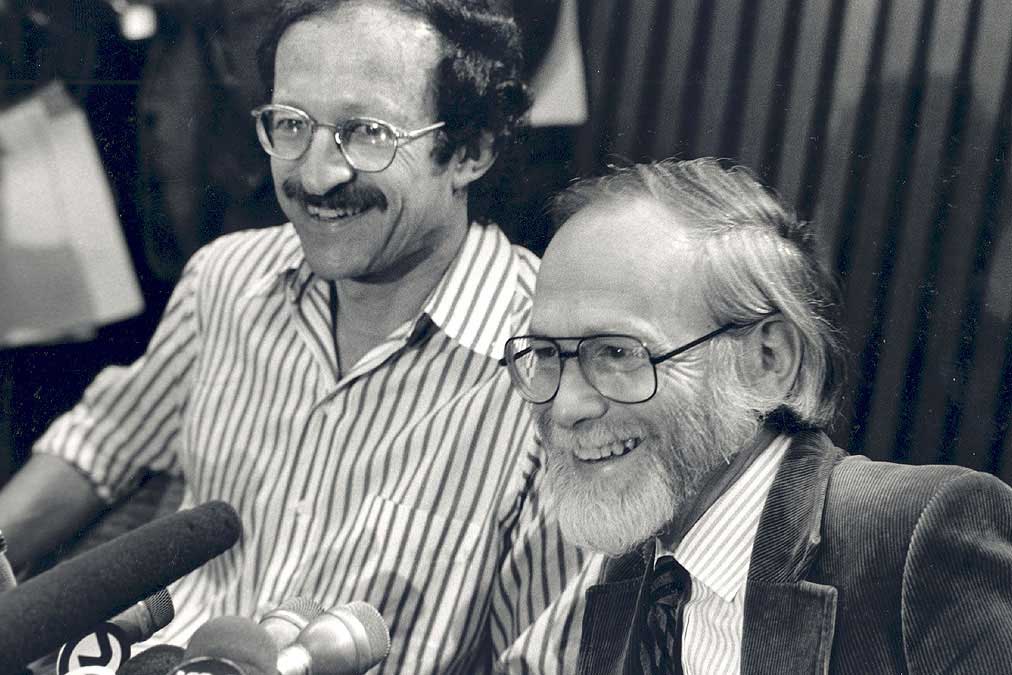
A breakthrough came in 1970 when a UC Berkeley postdoctoral fellow, G. Steve Martin, PhD, identified a viral gene, later dubbed src, which was shown to be the cancer-causing part of the RSV genome. That same year, Harold Varmus, MD, joined UCSF. His arrival launched a decades-long collaboration with Bishop that would lead to their sharing the 1989 Nobel Prize.
Together, Bishop and Varmus sought to understand how the src gene transformed healthy cells into malignancies. Their efforts yielded discoveries that reshaped the way scientists think about cancer and ushered in the modern age of cancer biology.
Breakthrough lays pathway to precision cancer medicine
In a series of now-famous experiments, Bishop and Varmus demonstrated that src wasn’t confined to the RSV genome — it was already present in virtually all healthy, non-cancerous animal cells, including those never infected by the virus.
This paradigm-shifting discovery suggested that cancer-causing genes, known today as “oncogenes,” are an innate part of every cell in the body. Subsequent work by Bishop and others showed that src was not unique — the human genome abounds with oncogenes. They went on to demonstrate that the src gene found in the RSV virus was likely to have originated from the src found in animal cells and that it integrated into the RSV genome at some point during its evolutionary history.
Bishop and Varmus’s discovery provided a unified framework for understanding cancer. They showed that cancer is fundamentally a genetic disease. But the theory also explained how cancer could result from environmental circumstances that affect oncogene activity.
Src and other oncogenes are required for normal cellular function. It’s their misbehavior that can cause cancer. Even healthy cells are now understood to harbor genes that can turn cells malignant under conditions that cause them to mutate or behave abnormally.
“The discovery that oncogenes are present within every one of our cells opened the pathway to the discovery of the mechanisms of cancer,” said Andrei Goga, MD, PhD, professor of cell and tissue biology at UCSF and a former postdoctoral researcher in Bishop’s lab. “This is what really led to the advent of precision cancer medicine and targeted therapies. It’s the basis of the genetic tests we use to identify cancer-causing genetic abnormalities and to determine whether someone has a familial predisposition to cancer.”
A scientist and chancellor who believed in the next generation
While producing trailblazing science, Bishop also served as a mentor to scores of young scientists, many of whom went on to successful careers in academia and industry. Former advisees fondly recall time spent under Bishop’s guidance, describing him as a caring advisor who, even after winning the Nobel Prize, went out of his way to advance the careers of promising young scientists.
His research forever changed our understanding of cancer and its underlying causes.
UCSF Chancellor Sam Hawgood, MBBS
“My time with Mike and Harold was tremendous,” said Deborah Spector, PhD, professor of Cellular and Molecular Medicine at UC San Diego, who co-authored a number of early oncogene papers with Bishop and Varmus as a postdoc in their lab in the late 1970s. “They always respected other people’s work. They didn’t compete with their postdocs and were always very supportive of their trainees.
“In part, I think their contributions to science are measured not just in what they themselves did in their labs, but in their progeny, seeding the field with many scientists who went on to do very important work,” she said. “It’s important to give them credit for this. It doesn’t take away from their genius that they were also terrific mentors.”
After establishing himself as one of the world’s leading scientists and an esteemed educator, Bishop was appointed UCSF’s eighth chancellor in July 1998. He is one of only two Nobel Laureates ever to serve as chancellor of a UC campus (the other was Glenn T. Seaborg, PhD, who was UC Berkeley chancellor from 1958 to 1961 after receiving the 1951 Nobel Prize in Chemistry).
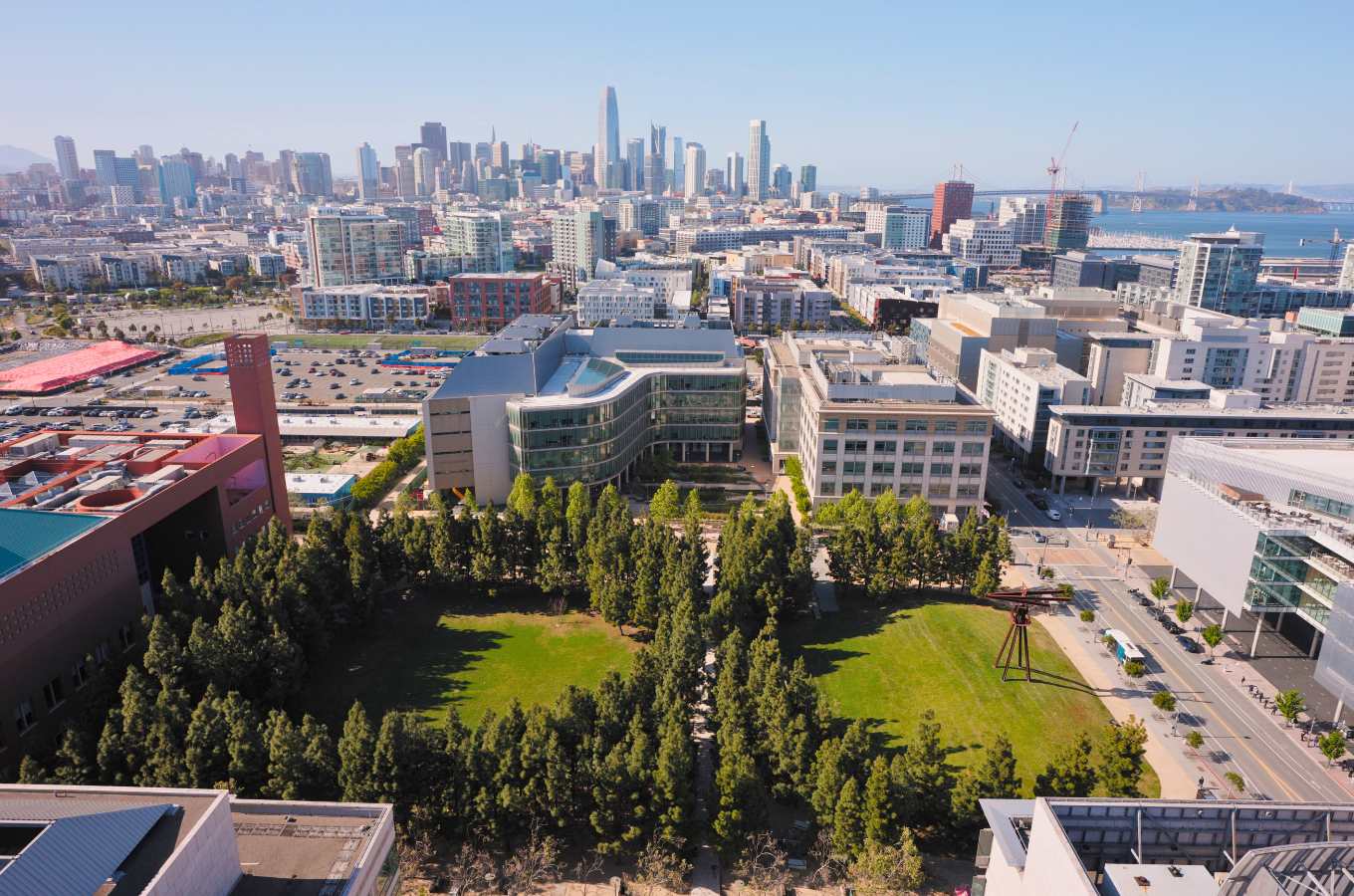
During his 11-year tenure — which lasted until August 2009 — he oversaw the development of UCSF’s Mission Bay campus, the single largest expansion in UCSF’s history.

Renaissance scientist leaves a legacy of research, art, and music
Best remembered as a towering figure in the world of science, Bishop’s career almost took a very different path. He was born in 1936 in the small town of Goldsboro, Pennsylvania, to a Lutheran pastor and his parishioner wife. That setting exposed him to the rich musical lexicon of the church and fostered his musical interests from an early age. It was music — not science — that was Bishop’s first love and intended career.
Bishop took voice, piano, and organ lessons, eventually serving as the organist of his father’s church for four years before attending Gettysburg College. Early in his college career, however, he realized that his passion for music exceeded his technical abilities.
“I didn’t have the talent to be a first-class musician,” Bishop said in a 2016 interview. “I clearly had academic talent. So, by the time I was in college, I had given up any formal training in music.”
At Gettysburg, Bishop studied chemistry, graduating summa cum laude in 1957. He went on to Harvard Medical School, where he received his medical degree in 1962, followed by postdoctoral work at Massachusetts General Hospital and the National Institutes of Health.
Music and the arts continued to play an outsized role in Bishop’s personal and professional life. Described as a “Renaissance scientist” by colleagues, he was known for his vast knowledge of art, music, literature, politics and — as a diehard San Francisco Giants fan — baseball.
“Mike was widely read on many, many subjects and could discuss them at a very high level,” Spector said.
An avid art collector, Bishop’s time as chancellor was notable for his efforts to incorporate contemporary art into public spaces at UCSF’s nascent Mission Bay campus. Setting aside one percent of the construction budget for each new building, Bishop assembled a committee of art advisors to commission site-specific works by some of the biggest names in contemporary art.
Today, the J. Michael Bishop Art Collection at UCSF Mission Bay includes more than 150 works by some 20 artists and is open to the campus community and the general public. It stands as a reminder of Bishop’s eclectic intellect and remains an important part of his legacy, serving as a lasting memorial to a giant of the UCSF community.
Bishop is survived by his two sons, Dylan and Eliot, his sister, and five grandchildren. His wife Kathryn (Putnam) Bishop passed away in 2016.