
How 100,000 Grandmas Fight Cancer in Every Human Cell
From curing Alzheimer’s to preventing cancer and pneumonia, UCSF postdoctoral scholars tackle complex medical conditions at annual Postdoc Slam competition.
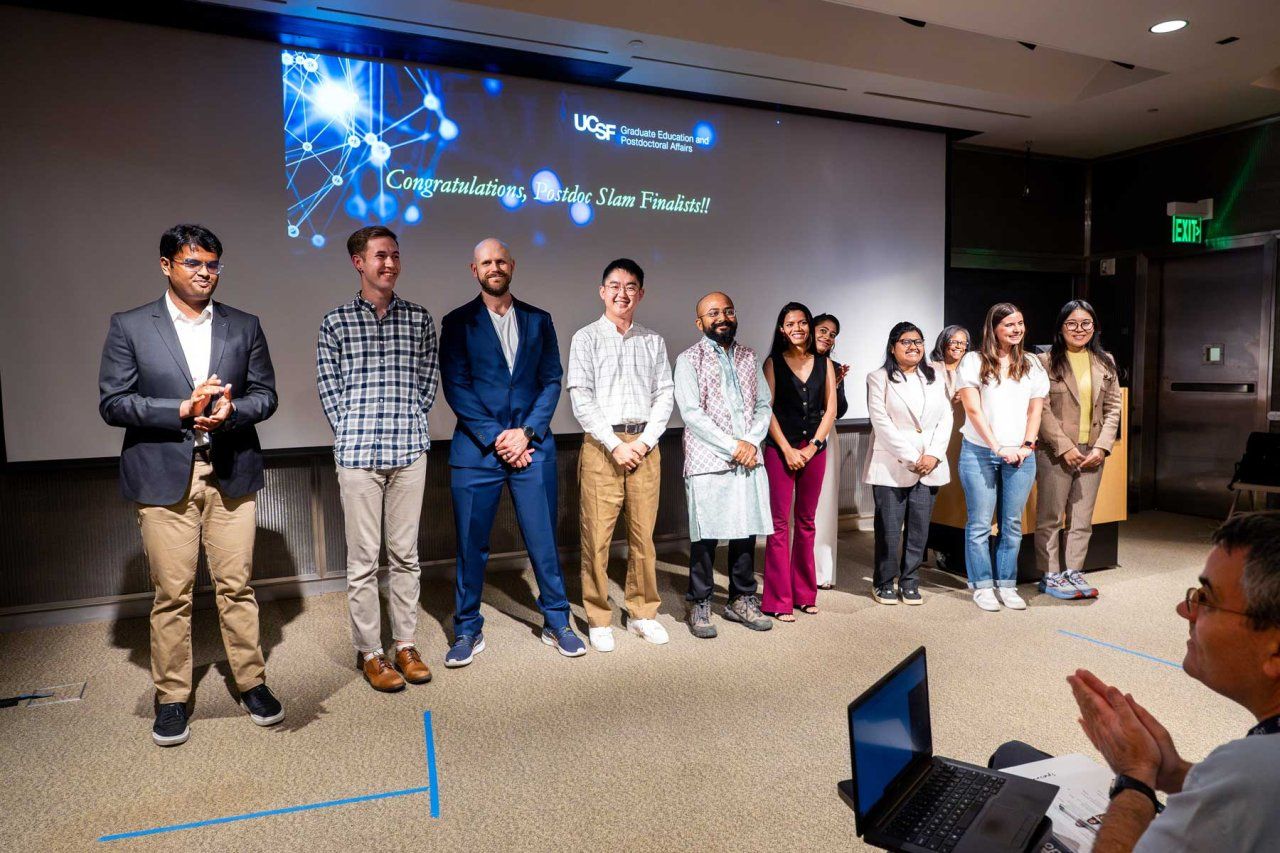
“Tangled string is a nuisance when knitting, but did you know that tangled string can also cause cancer?” asked Atreya Dey, PhD, a postdoctoral scholar at UC San Francisco’s Postdoc Slam competition on Sept. 17.
Speaking to a live and virtual audience of nearly 600 at UCSF’s Genentech Auditorium at the Mission Bay campus, Dey recalled mischievously unraveling his grandmother’s knitting yarn as a child — then paralleled the anecdote to the six-foot strand of DNA that exists in every cell. A tangled strand during cell division can cause conditions like cancer and Down Syndrome, he said.
Dey’s presentation about the tangled DNA earned him first prize among the 10 postdoctoral finalists competing for the top prize of $4,000. Finalists were limited to three-minute presentations of their research, TED Talk-style, to spectators and a panel of judges. Each year, Postdoc Slam is the featured event in UCSF’s celebration of National Postdoc Appreciation Week, which celebrates and recognizes the contributions of postdoctoral scholars to research and discovery at institutions worldwide.
“Our rockstar postdocs are the silent engines of our community, bringing their best talents to labs and workspaces every day to push the boundaries of innovation,” said Nicquet Blake, PhD, vice provost and dean, Division of Graduate Education and Postdoctoral Affairs.
Watch the winning talk: Atreya Dey, PhD, won first place at this year’s Postdoc Slam. Watch his award-winning talk, “Theory of 100,000 Grandmas.”
“Grandmas in my cells”
Dey’s presentation, “Theory of 100,000 Grandmas,” explained the natural folding of the DNA strand in each cell of the body during cell division. This folding can cause tangles but is usually controlled by a protein called "condensin," which keeps the DNA in check during the complex cell division process. He likened condensin to his grandmother, patiently untangling the knots in his messy bundle of yarn.
Dey’s lab, led by faculty advisors Andrej Sali, PhD, and Ignacia Echeverria Riesco, PhD, built a computational model to study how condensin rapidly folds the meters-long human genome into micrometer-sized chromosomes. Their experiments revealed that there are 100,000 condensin proteins present in a single cell and showed what the condensin should look like when correctly packaged in the cell before division. This research is creating a framework for understanding and verifying the chromosome folding process, which could lead to improved treatments for diseases, like cancer and Down Syndrome, which are caused by misfolding chromosomes.
Dey lightheartedly concluded his presentation by expressing his gratitude to the “100,000 grandmas in my cells, protecting me from cancer.”
What happens when the brain’s clean-up crew doesn’t get the message?
Second place winner, Jarin Tusnim, PhD, received a $2,000 prize for her presentation, “Breaking the Silence: How Astrocytic GPR56 Can Protect the Alzheimer’s Brain.”
Tusnim described how GPR56 — a G-protein receptor on brain cells called astrocytes that keep the brain functioning smoothly — communicate with the brain’s cleanup crew, microglia, to help protect the brain from Alzheimer’s disease. Tusnim’s research, led by her faculty advisor, Xianhua Piao, MD, PhD, is decoding the cellular conversation between astrocytes and microglia to identify new drugs to target for a cure for Alzheimer’s.
Preventing pneumonia by re-learning to swallow
Rabab Rangwala, PhD, CCC-SLP, was the third-place winner, receiving $1,000, and stole the audience’s hearts as the People’s Choice Award winner, which came with an additional $750.
Rangwala’s presentation, “Where There’s a Swallow, There’s a Synchrony,” described the sometimes-deadly impact of Parkinson’s disease on patients’ abilities to swallow food or water. She explained that the process of exhaling, pausing, swallowing, and exhaling again, is taken for granted in healthy patients. However, for patients with Parkinson’s Disease, the breathing rhythm falters, the swallowing reflex gets out of sync with the patient’s breath, and food and liquids go down the wrong way into the lungs. This can cause a dangerous form of pneumonia, which is a leading cause of death in patients with Parkinson’s disease.
“By understanding how Parkinson’s changes the rhythm between breathing and swallowing, I hope to help improve care and lower risks like choking or aspiration to inform more effective treatments,” Rangwala said. Her faculty advisor is Srikantan Nagarajan, PhD.
2025 UCSF Postdoc Slam Finalists

Atreya Dey, PhD
“A Theory of 100,000 Grandmas”
Faculty advisors: Andrej Sali, PhD and Ignacia Echeverria Riesco, PhD
Watch Atreya’s talk

Logan Leak, PhD
“When Worlds Collide: Oncogenic Fusion Proteins in Lung Cancer”
Faculty advisor: Trever Bivona, MD, PhD
Watch Logan’s talk
Weicheng Li, PhD
“Rewriting the Rules of Cellular Quality Control”
Faculty advisor: Jonathan Ostrem, MD, PhD
Watch Weicheng’s talk

Lea Lortal, PhD
“Cracking the Genetic Code of a Deadly Fungus”
Faculty advisor: Hiten Madhani, MD, PhD
Watch Lea’s talk

Jack Moen, PhD
“From Beast to Bedside: Animal Biology That Heals”
Faculty advisor: Nevan Krogan, PhD
Watch Jack’s talk
Sangeeta Niranjan, PhD
“From Hide-and-Seek to Spotlight: Nanobodies Expose Calcium Channel Secrets”
Faculty advisor: Daniel Minor, Jr., PhD
Watch Sangeeta’s talk

Rabab Rangwala, PhD, CCC-SLP
“Where There’s a Swallow, There’s a Synchrony”
Faculty advisor: Srikantan Nagarajan, PhD
Watch Rabab’s talk
Jarin Tusnim, PhD
“Breaking the Silence: How Astrocytic GPR56 Can Protect the Alzheimer’s Brain”
Faculty advisor: Xianhua Piao, MD, PhD
Watch Jarin’s talk
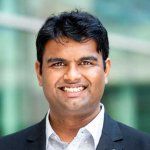
Ritwik Vatsyayan, PhD
“Chronic Pain: Is it All in the Brain?”
Faculty advisor: Prasad Shirvalkar, MD, PhD
Watch Ritwik’s talk

Da Zhang, PhD, MSc
“AI-Powered Epilepsy Detection: Bridging Gaps in Care”
Faculty advisor: Jon Kleen, MD, PhD
Watch Da’s talk
Panel of Judges
- Erin Allday, staff writer for the San Francisco Chronicle
- Uwe Klein, PhD, senior vice president, biological sciences, at Septerna; UCSF postdoc alum; executive board member, UCSF Graduate and Postdoc Alumni Association
- Leti McNeill Light, associate vice chancellor for University Development and Alumni Relations at UCSF; president, Strategic Initiatives Group for Advancement Professionals
- Julianna Mululu, MEd, CTE Health Sciences instructor within the Health and Behavioral Science Pathway, San Francisco Unified School District
- Jennifer Nazareno, PhD, associate dean of academic affairs, UCSF Graduate Education and Postdoctoral Affairs; UCSF sociology PhD alum
2025 UCSF Postdoc Slam Finalists
Atreya Dey, PhD
“A Theory of 100,000 Grandmas”
Faculty advisors: Andrej Sali, PhD and Ignacia Echeverria Riesco, PhD
Watch Atreya’s talk
Logan Leak, PhD
“When Worlds Collide: Oncogenic Fusion Proteins in Lung Cancer”
Faculty advisor: Trever Bivona, MD, PhD
Watch Logan’s talk
Weicheng Li, PhD
“Rewriting the Rules of Cellular Quality Control”
Faculty advisor: Jonathan Ostrem, MD, PhD
Watch Weicheng’s talk
Lea Lortal, PhD
“Cracking the Genetic Code of a Deadly Fungus”
Faculty advisor: Hiten Madhani, MD, PhD
Watch Lea’s talk
Jack Moen, PhD
“From Beast to Bedside: Animal Biology That Heals”
Faculty advisor: Nevan Krogan, PhD
Watch Jack’s talk
Sangeeta Niranjan, PhD
“From Hide-and-Seek to Spotlight: Nanobodies Expose Calcium Channel Secrets”
Faculty advisor: Daniel Minor, Jr., PhD
Watch Sangeeta’s talk
Rabab Rangwala, PhD, CCC-SLP
“Where There’s a Swallow, There’s a Synchrony”
Faculty advisor: Srikantan Nagarajan, PhD
Watch Rabab’s talk
Jarin Tusnim, PhD
“Breaking the Silence: How Astrocytic GPR56 Can Protect the Alzheimer’s Brain”
Faculty advisor: Xianhua Piao, MD, PhD
Watch Jarin’s talk
Ritwik Vatsyayan, PhD
“Chronic Pain: Is it All in the Brain?”
Faculty advisor: Prasad Shirvalkar, MD, PhD
Watch Ritwik’s talk
Da Zhang, PhD, MSc
“AI-Powered Epilepsy Detection: Bridging Gaps in Care”
Faculty advisor: Jon Kleen, MD, PhD
Watch Da’s talk
Panel of Judges
- Erin Allday, staff writer for the San Francisco Chronicle
- Uwe Klein, PhD, senior vice president, biological sciences, at Septerna; UCSF postdoc alum; executive board member, UCSF Graduate and Postdoc Alumni Association
- Leti McNeill Light, associate vice chancellor for University Development and Alumni Relations at UCSF; president, Strategic Initiatives Group for Advancement Professionals
- Julianna Mululu, MEd, CTE Health Sciences instructor within the Health and Behavioral Science Pathway, San Francisco Unified School District
- Jennifer Nazareno, PhD, associate dean of academic affairs, UCSF Graduate Education and Postdoctoral Affairs; UCSF sociology PhD alum