
Can An AI Chatbot Help Women Recognize Heart Disease?
UCSF nurse scientist creates HeartBot to provide real-time answers to life-saving cardiac questions

“I read that people mistake a heart attack for heartburn. How do I know the difference?”
“Are heart disease symptoms different in women than in men?”
“How so?”
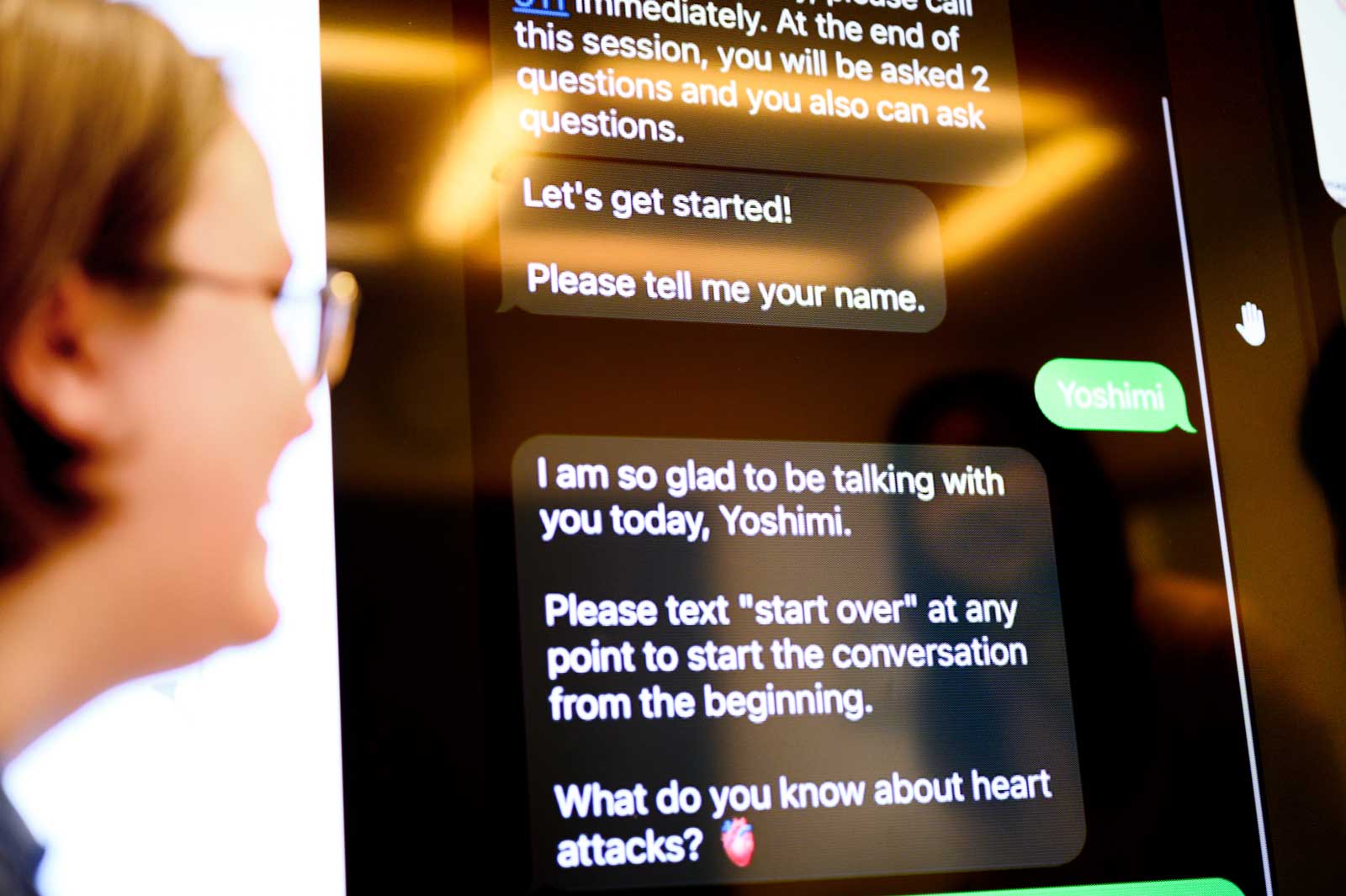
These are some of the questions HeartBot regularly answers for women seeking information on heart disease. It was created by a team of UC researchers, led by Yoshimi Fukuoka, PhD, RN, FAAN, a nurse scientist and professor at UC San Francisco’s School of Nursing. The goal was to study whether having a heart-health chatbot on their phone would increase study participants’ awareness of heart disease risks and recognition of heart attack symptoms so they would seek medical help when necessary.
Each conversation is personalized. HeartBot can recall a previous conversation with a user and acknowledge an earlier mention of a family member who experienced a heart attack, for example.
Study participants talked with HeartBot about the basics of heart disease, heart attack symptoms, risk factors, and prevention in real time. For instance, it explained that while chest pain is common for both women and men, women are more likely to experience shortness of breath, nausea, vomiting, and pain in the back or jaw. These symptoms are less obvious and may be mistaken for other conditions.
60 million women
Providing information to help women recognize heart disease risk symptoms was what drove Fukuoka to create HeartBot.
Heart disease remains the leading cause of death among women and affects more than 60 million women in the U.S., with the highest prevalence among non-Hispanic Black women. One in 3 women die from heart disease, according to the American Heart Association. Yet, despite decades of public health campaigns, women’s awareness of the causes, risks, and symptoms has declined. Women who reported knowing heart disease was the leading cause of death dropped from 65% in 2009 to 44% in 2019, with the steepest declines occurring among Black, Hispanic, and younger women.
“I strongly believed we needed a more innovative approach, beyond traditional media campaigns, to increase awareness of heart disease among women — especially among underserved populations,” Fukuoka said.
Teaching a bot to talk about the heart
Originally launched in 2021, HeartBot was based on research from an interdisciplinary team of cardiovascular nursing scientists, linguists, communication scientists, computer scientists, biostatisticians, programmers, and graduate students from UCSF, UCLA, and UC Davis.
The team compiled almost 600 potential user questions, along with research-based responses to variations of each. They also studied the language, rhythm, and cadence of how women talk about heart disease, aiming to make engaging with HeartBot feel more like a conversation with another person.
“The goal was to increase women’s awareness and knowledge of heart disease as a precursor to a heart attack and promote appropriate care-seeking behavior, particularly calling 911 when experiencing potential heart attack symptoms,” Fukuoka said.
Keeping AI on a short leash
The current HeartBot II model, enhanced in 2025, was upgraded to include learning modules covering the basics of heart disease, heart attack symptoms, risk factors, and prevention. It also transitioned from being SMS text-based to a chatbot app, based on a large language model (LLM) application to support natural and personalized conversations. The app is currently available to trial participants on the Apple App Store and Google Play Store. Fukuoka’s research team plans to make HeartBot available to the broader public once its efficacy and safety are established. HeartBot’s responses come from a core knowledge bank developed by Fukuoka’s team and is designed to reduce the chance of AI producing false or misleading medical information.
It was important for the researchers to use non-medical terms and a vocabulary that is understandable to an average user. For instance, they discovered through feedback that seemingly ordinary medical phrases such as “risk” and “risk factors” weren’t always clear. So, subsequent versions were edited to include everyday language, and the user feedback was positive.
“Getting accurate health information to women was not enough,” Fukuoka said. “The information also had to be understandable and engaging enough for women to use it.”
When minutes matter
In a new study, Fukuoka moves beyond asking if women will engage with the bot to whether they will retain the information enough to improve their knowledge of heart disease, including their ability to recognize the signs of a heart attack.
To find out, she is completing a more rigorous six-month randomized controlled trial with 201 female UCSF Health patients. Half will have immediate access to the HeartBot II educational sessions. The second half will serve as a control group, receiving access later.
Researchers will compare changes in the women’s retention of heart disease information over time.
Fukuoka’s long-term vision is to test the next version of HeartBot with several thousand women for even longer, and eventually make the tool more broadly accessible, such as placing HeartBot QR codes in clinics and public transportation spaces for easy access.
For now, the experiment is smaller, but Fukuoka’s question is still “can a conversation with AI help women recognize the warning signs of a heart attack and know what to do when minutes matter?”