
These Nurses’ Research Could Help Save You or Your Child’s Life
From airlifting acutely ill babies to adult diabetes education, UCSF clinical nurses are advancing innovations in care based on rigorous scientific research.
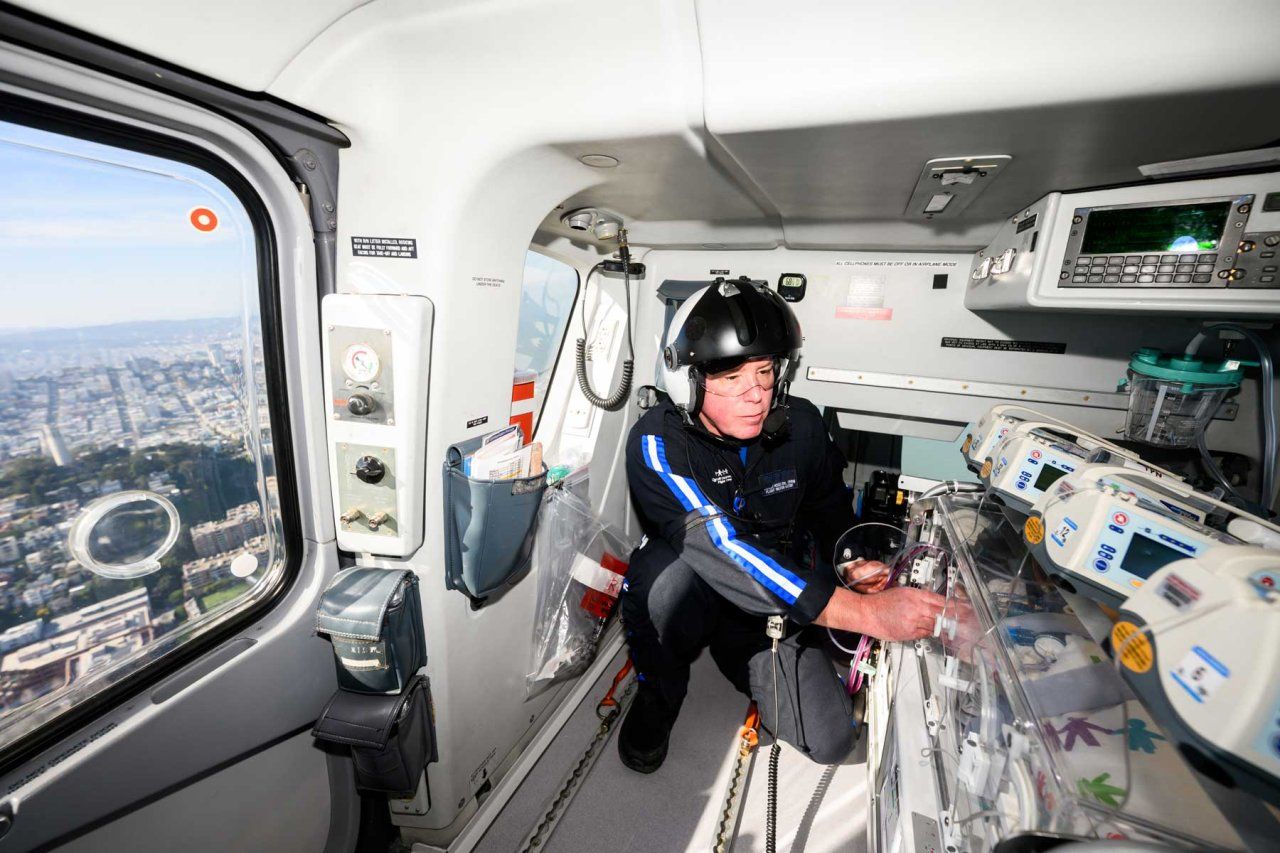
As a critical care transport nurse, Charles Hood, RN, CFRN, has rushed hundreds of newborns, children, and teenagers to UCSF Benioff Children’s Hospitals in San Francisco and Oakland for life-saving treatment.
He instinctively knows where to find the necessary catheters, medication, and machinery in the cramped aircraft cabin of Bear Force One — UCSF’s Benioff Hospitals’ emergency transport helicopter. When seconds are crucial, he calmly administers complex treatments despite occasional turbulence and monitors his patient’s vital signs as if in a hospital critical care unit. Except his working space is one-tenth the size.
“These are the sickest patients you are going to see,” Hood said. “We’re attempting to do high-level neonatal intensive care unit (NICU) and pediatric intensive care unit (PICU) care in the back of a confined space with limited resources. You have to think fast and know how to manage the patient when their condition changes.”
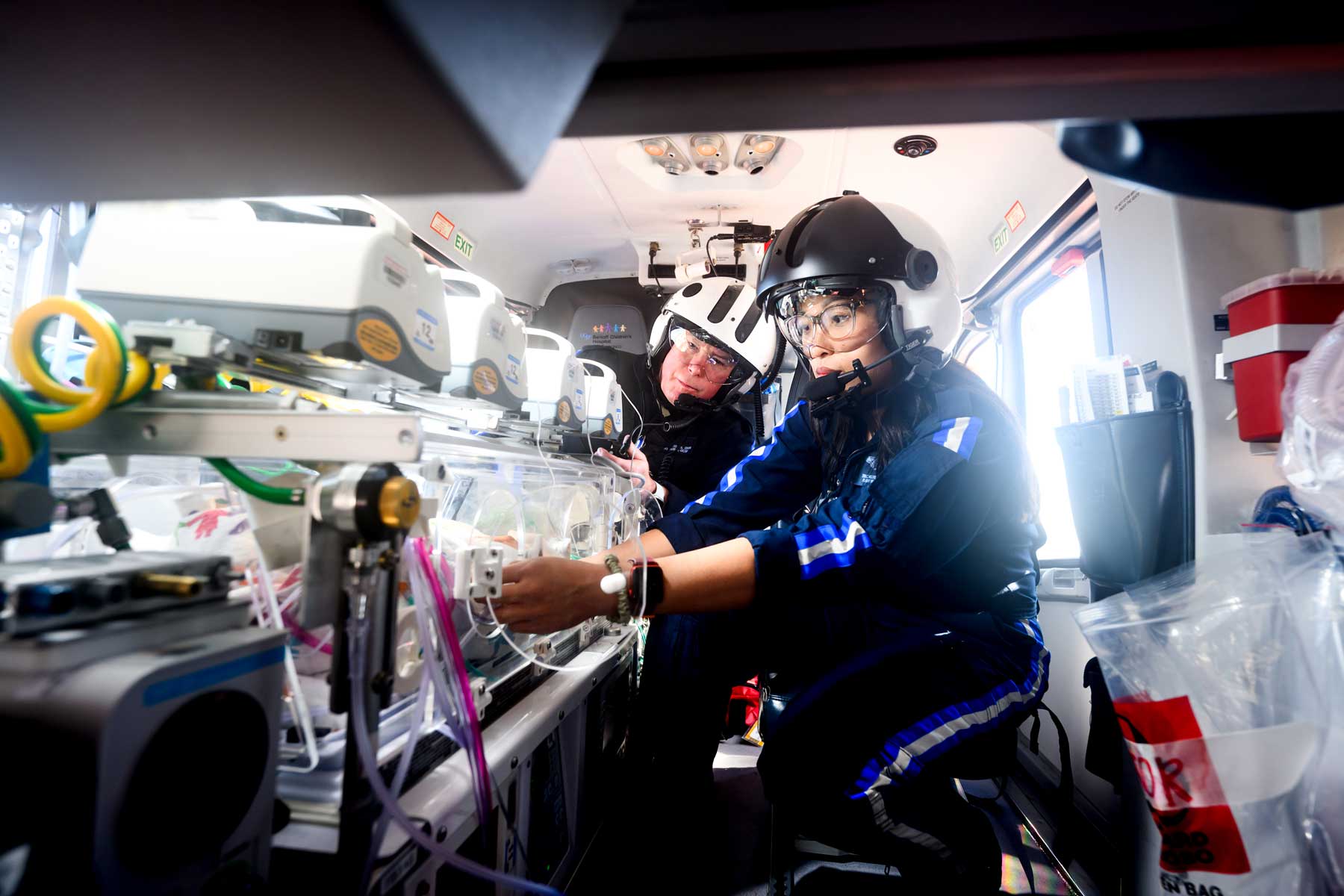
Hood, who is passionate about his work, came up with the idea to expand UCSF’s critical care transport team to serve children throughout the state and region, but was surprised there were no existing training courses for the helicopter’s essential instrument that helps newborns breathe.
“We needed more staff trained to operate high-frequency ventilators during transport in order to meet the need for our most critical neonatal and pediatric patients, but there were no formal training modules that we could all refer to,” Hood said. “I realized we’d have to create them ourselves.”
Dynamic duo: clinical nurses and nurse scientists
Hood received a Clinical Nursing Research (CNR) grant to develop and test a training program for the ventilator. The one- to two-year grant, jointly administered by UCSF Health’s Center for Nursing Excellence and Innovation (CNEI) and UCSF’s School of Nursing, pairs clinical nurses with PhD-prepared nurse scientists to conduct research in areas that aim to improve patient care and outcomes.
We support frontline nursing research that has a direct impact on patients.
Maria Yefimova, PhD, RN
The 30-year-old program has supported around 50-60 research projects, some projects end up being incorporated into patient care protocols and published in major peer-reviewed journals like Applied Nursing Research, Journal of Patient Experience, and Journal of Infusion Nursing.
“We support frontline nursing research that has a direct impact on patients,” said Maria Yefimova, PhD, RN, lead nurse scientist of the Research and Scholarship team at CNEI and assistant adjunct professor, Department of Physiological Nursing, UCSF School of Nursing. “It isn’t theoretical, it’s research rooted in what nurses see and do every day. Clinical nurses and faculty are equal partners here — it’s truly collaborative.”
For his project, Hood partnered with Sandra Staveski, PhD, RN, associate professor for the School of Nursing and pediatric complex care nurse scientist, whose expertise he relied on to navigate the research grant writing and management processes. He also collaborated with Mandeep Chadha, MD, clinical professor with the Division of Pediatric Critical Medicine, to design video and simulation training modules for the high-speed ventilator.
Hood and Chadha’s simulation modules covered scenarios that emergency transport nurses often encounter when using the ventilator en route — and are now required training for UCSF pediatric medical transportation teams working in ambulances, helicopters, and airplanes.
Catch patients with diabetes distress before they fall through the cracks
Esther Rov-lkpah, RN, another CNR grant recipient and diabetes education specialist at UCSF Helen Diller Medical Center, wanted to know why many of her patients were coming in after emergency department visits for dangerously high or low blood sugar, cardiac issues, or other serious diabetes symptoms.
Paired up with Elena Flowers, PhD, RN, professor of physiological nursing at the School of Nursing and a diabetes researcher, Rov-lkpah's grant allowed her to survey patients about diabetes distress, which results from the frustrations, worries, and burnout associated with the daily demands of managing the disease.
“Diabetes distress is the emotional side of diabetes, and it is real,” Rov-lkpah said. “Managing diabetes touches almost every aspect of a patient’s daily life — what to eat, when to travel, exercise, and even intimacy. The worries can be overwhelming.”
Similar research among outpatients has shown some patients reduce their insulin to address cost concerns, skip doctor’s visits due to exhaustion from so many appointments, and self-modify their medications due to fears about high or low blood sugar — all of which can result in emergency room trips.
According to the Centers for Disease Control and Prevention, more than 40 million Americans, or 12% of the population, are living with diabetes. In addition, the prevalence of "significant” diabetes distress was about 42% for adults with Type 2 diabetes and about 43% in adults with Type 1 diabetes,” according to a 2019 study led by Lawrence Fisher, PhD, UCSF professor emeritus, and published in Diabetic Medicine.
Rov-lkpah speculated that adequately assessing and addressing the root-cause of her patients’ worries could potentially improve their diabetes management and reduce their need for ED visits.
“Without that conversation about their fears, and education about managing their diabetes as relates to their concerns, the problem continues,” she said.
The Rov-lkpah and Flowers diabetes project is still in progress, but if results are conclusive, the team plans to submit the findings for publication in a peer-reviewed diabetes journal. They’re also explore applying the diabetes distress survey to inpatient areas at UCSF hospitals as part of standard care. The next phase of the research will be to develop solutions for the concerns causing the most distress.
“I had no prior experience doing research but (Flowers) walked me through the grant writing process, shared her experiences with the review board, and edited my proposal,” Rov-lkpah said. “If I had to do this research project alone, I probably would not have started because I did not understand how to go about it.”
Other CNR projects have included research to improve methods to identify early hearing loss in elderly patients, reduce needle pricks when drawing blood by using strategies to more easily identify viable veins, and streamlining the hospital discharge process.
“These are just a few examples of how the nurse-led CNR grants have directly informed improvements in patient care at UCSF,” Yefimova said.