
Industry Partnerships
In recent years, UCSF has revamped and streamlined its approach to industry partnerships to help move research more quickly and strategically from the laboratory to clinical trials and patient treatment.
These efforts are led by Innovation Ventures, under the direction of David Morris, MD, vice chancellor for Business Development, Innovation & Partnerships. Innovation Ventures' goal is the ensure that the best new therapies and technologies can make their way to patients as safely and efficiently as possible. Innovation Ventures works with researchers at UCSF to develop their ideas, and with partners in industry and investors to forge collaborations and license UCSF innovations.
The many industry partnerships across UCSF include:
Arc Institute
UCSF, UC Berkeley and Stanford University are founding scientific members of the Palo Alto-based Arc Institute, which supports curiosity-driven research, new career paths in science, collaborations and translating discoveries into new therapies. Arc investigators include faculty as well as students who are doing their PhD studies at Arc labs. The institute has raised the funds to fully support scientists and their research for renewable, eight-year terms.
Autobahn Labs
Autobahn Labs is a “virtual incubator” focused on drug discovery and development. It works with scientists to identify promising preclinical science and invest the resources to move projects through an established drug discovery pipeline and form jointly owned ventures to translate scientific ideas into novel therapeutics.
Chan Zuckerberg Biohub San Francisco
In addition to hosting its own ambitious intramural research programs focused on cells and dynamic cellular systems, the Chan Zuckerberg Biohub San Francisco provides unrestricted funding to about 120 Investigators at UCSF, UC Berkeley and Stanford University. Headquartered next to UCSF’s Mission Bay campus, CZ Biohub San Francisco is part of the CZ Biohub Network, a family of four nonprofit research institutes across the U.S. that bring together physicians, scientists and engineers at top research universities to pursue grand scientific challenges on 10- to 15-year time horizons.
Eli Lilly and Company
UC San Francisco has formed a research alliance with Eli Lilly and Company based on the Immunoprofiler model launched at UCSF in 2017 to study autoimmune diseases, such as lupus, inflammatory bowel disease and type 1 diabetes. AutoImmunoprofiler aims to bring other pharmaceutical companies to the consortium. All partner investors will have access to research data generated from biological samples in the CoLabs facilities at UCSF.
Foundery Innovations
Foundery is a biotechnology venture studio focused on translating immunology discoveries into drug candidates. The partnership is designed to support UCSF investigator research and create opportunities to develop and commercialize immunotherapies. Foundery aims to transition the preclinical candidate either directly via sale to biopharmaceutical partners or through the creation of a financing syndicate with later-stage venture capital funds to develop the program.
Genentech & Roche
The Alliance for Therapies in Neuroscience (ATN) is a project of the Weill Neurohub, a joint research collaboration between UCSF, UC Berkeley, the University of Washington and the Allen Institute, to develop therapeutics for Alzheimer’s, Parkinson’s, Huntington’s, ALS and autism.
GSK
GSK is collaborating with UCSF and Berkeley on a state-of-the-art laboratory to use CRISPR technologies to explore how genes cause disease and to accelerate the discovery of new medicines, with a focus on immunology, neuroscience and oncology.
PICI
The Parker Institute for Cancer Immunotherapy (PICI) brings together the nation’s top immunotherapy cancer researchers and clinicians to accelerate the development of breakthrough immune therapies. The institute includes six of the country’s top cancer centers – UCSF, Memorial Sloan Kettering Cancer Center, Stanford Medicine, UCLA, the University of Pennsylvania and the University of Texas MD Anderson Cancer Center.
Community Partnerships
Consistent with its mission as a public university, UCSF is committed to forging fruitful relationships that provide support to and strengthen the community at large.
The UCSF Clinical and Translational Science Institute (CTSI) leads many of the University's community partnership efforts through its Community Engagement and Health Policy Program. The program aims to bridge academic research, health policy, and community practice to improve public health, and its goals are to:
- Increase community participation in all stages of research to improve research-based practice and stimulate practice-based research.
- Provide research and guidance for policy changes at the local, state and national levels.
- Foster strong relationships for research collaboration between community health providers, policy makers, and academic researchers.
- Identify key research opportunities and support the development of useful research tools.

The San Francisco Health Improvement Partnership (SFHIP) joins public, nonprofit and private stakeholders to improve public health. Photo by Susan Merrell
As part of this effort, CTSI hosts the Center for Community Engagement, formerly called University Community Partnerships, which works to strengthen the University’s connection with the community and to empower the community to work with the University. The emphasis is on collaboration that values and respects the assets and diversity of both.
Two initiatives by the Community Engagement and Health Policy Program are:
- San Francisco Health Improvement Partnership (SFHIP), a citywide effort rallying the San Francisco Department of Public Health, San Francisco Unified Public School District, the Mayor's Office, as well as nonprofit and private stakeholders. The underlying premise for establishing SFHIP is that by working together in a coordinated, focused, and well-informed manner, groups can achieve synergies and foster innovation to achieve more substantial gains in community health and health equity. UCSF has worked with SFHIP to identify four priority areas for developing community interventions based on research conducted here: physical activity and nutrition, alcohol policy, children's oral health, and hepatitis B.
- San Francisco Bay Area Collaborative Research Network (SF Bay CRN), a practice-based research network designed to encourage, facilitate and lead mutually beneficial practice-based research partnerships between UCSF researchers and community-based primary health care organizations, practices, and clinicians in the San Francisco Bay Area and Northern California. The network provides consultation, linkage and pilot funding.
The UCSF Helen Diller Comprehensive Cancer Center also leads a citywide collaboration that aims to reduce cancer in San Francisco by engaging health care systems, government, community groups and residents.

Bob Hiatt (left), MD, PhD, and Kirsten Bibbins-Domingo (center), PhD, MD, MAS, at the launch event for the San Francisco Cancer Initiative at City Hall in 2016. Photo by Noah Berger
The San Francisco Cancer Initiative (SF CAN), launched in 2016, is targeting five of the city’s most common cancers likely to be affected by known interventions or better screening. Since many of those cancers affect certain racial and ethnic minorities and the socially disadvantaged more than other groups, a primary focus of SF CAN is reducing inequities in prevention, screening rates, access to quality healthcare, and outcomes.
Global Partnerships
An internationally renowned health sciences institution, UCSF maintains a reach that goes well beyond U.S. borders. Accomplishments and contributions by UCSF basic science and clinical research teams have transformed health and health care worldwide in HIV/AIDS, malaria, tuberculosis, tobacco use, emergency medicine and numerous other areas.
At the center of international outreach is the UCSF Institute for Global Health Sciences (IGHS), which works with partners in countries throughout the world to improve health and reduce the burden of disease in the world’s most vulnerable populations. First established in 1999, the Institute for Global Health Sciences involves an innovative team of educators, researchers and health care professionals working around the world to train global health leaders and build sustainable solutions to improve health and eliminate disease.
UCSF currently has more than 600 UCSF investigators from each school conducting projects in more than 190 countries:
Africa
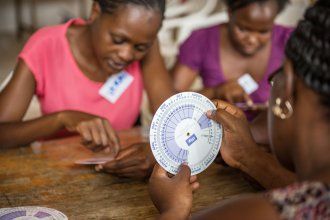
In Rongo, Kenya, hospital trainees use a chart developed through the UCSF East Africa Preterm Birth Initiative to determine how preterm a baby is. Photo by Matthew Gillooley
UCSF research mirrors the numerous and diverse sub-regions of Africa, but many projects are focused on HIV/AIDS, malaria and maternal and newborn child health. Eastern Africa has a high burden of parasitic and other infectious diseases, and has been particularly affected by the HIV/AIDS epidemic. The East Africa Preterm Birth Initiative aims to improve the quality of facility care for mothers and newborns through a package of interventions in Kenya and Uganda and group antenatal and postnatal care in Rwanda.
UCSF researchers have been actively involved with capacity building and technical assistance for HIV care and prevention in Western Africa. In Northern Africa, UCSF researchers are involved with testing hepatitis C treatment.
Asia
Much of UCSF's work is associated with the epidemiology, prevention and control of infectious disease, principally HIV, malaria and tuberculosis. For instance, The Malaria Elimination Initiative of the Global Health Group at IGHS has been working to support countries for malaria control and elimination in Asia. In the field of prevention and harm reduction, researchers have been studying substance abuse in China and Iran. Other research efforts focus on empowerment of women, improving the quality of care for maternal and reproductive health, and HIV prevention among high-risk women and girls.
Europe
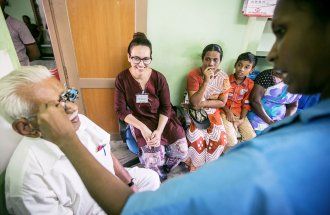
UCSF graduate student Jamen Rose Garcia observes an eye exam in a village near Madurai, India, as part of research on the world-renowned Aravind Eye Care System. Photo by Paul Joseph Brown
Though often overlooked in lists of activities pertaining to global health, European collaborations with UCSF researchers are very common. Large clinical trials studying medications for diseases such as heart disease, cancer, or HIV often include European cohorts in their studies. UCSF scientists often gain training in Europe and vice versa. UCSF researchers are part of trans-national networks that study topics as diverse as neonatal stroke and HIV and hepatitis C coinfection among people who inject drugs (PWID).
Latin America and the Caribbean
UCSF researchers are involved in a range of projects researching public health and medicine, from tracking viral pathogens in Nicaragua, to large-scale clinical trials in Mexico of medication to delay the onset of diabetes, to policy research on the prices of essential medications. The Global Strategic Information group in IGHS has been involved in PEPFAR implementation in selected regions of the Caribbean and Latin America and has hosted Fogarty scholars from Brazil.
North America
Many UCSF projects that seek to build capacity and solve research problems with a worldwide scope are based in Northern America, often on UCSF campuses and in university laboratories. Most projects addressing the science of drug screening or development to treat neglected tropical diseases are unfolding in UCSF laboratories at Parnassus or Mission Bay. Likewise, many projects that address the specific health needs or ailments of immigrants and refugees are based in the United States or Canada. The UCSF Department of Emergency Medicine has been designated a World Health Organization Collaborating Centre, the only such centre in the US. In some cases, research on topics such as the immunology of HIV infection may have implications far beyond the San Francisco clinics and laboratories where it is based.
Oceania
UCSF's Malaria Elimination Initiative and the Pacific AIDS Education and Training Center work to improve local capacity to respond to malaria and HIV in Oceania. In addition to epidemiology, prevention, and control activities related to infectious disease, UCSF researchers are investigating the genetics of schizophrenia among isolated populations in Palau and participate in international clinical trial networks that include Australian cohorts.