
About the Campus
Changing the Landscape
Along the shores of San Francisco Bay, just south of AT&T Park, a long-underused swath of land began to realize a potential greater than anything the city could have imagined when, in 2003, UCSF opened Genentech Hall, the first building on its Mission Bay campus.
Over the past decade, UCSF Mission Bay has bloomed into a vibrant and vital campus and biotechnology hub, where academia and industry come together for cutting-edge, lifesaving research. It is also the place where the next generation of basic scientists, clinical researchers, doctors, nurses, pharmacists and dentists learn with the most modern tools available.
Now, this major campus for UCSF’s research and education programs has become home to San Francisco’s first new hospital in 30 years. UCSF Medical Center at Mission Bay opened in February 2015, designed specifically to set new standards in patient care, and to support groundbreaking partnerships between basic science and clinical researchers that will speed the delivery of new therapies to benefit patients.
Today, UCSF Mission Bay is a hub for thousands of UCSF faculty, staff, students, patients and other visitors. But it took visionaries and the help of the community to turn this onetime marsh-turned-neglected area into a national model for health sciences research, patient care and creation of new jobs.
The transformation of UCSF Mission Bay into a thriving biotechnology center has been an economic boon for San Francisco, according to an economic impact report released in 2010. The development of the UCSF Mission Bay campus has been a significant catalyst to the San Francisco Bay Area biotechnology industry.
In fact, UCSF’s presence at Mission Bay has enabled San Francisco to attract bioscience back within city limits, growing from one company when UCSF's Genentech Hall opened in 2003, to more than 100 in 2013. The campus is immediately surrounded by a growing and collaborative ecosystem of more than 50 bioscience startups, nine established pharmaceutical and biotech companies, 10 venture capital firms, and scientific leaders such as the J. David Gladstone Institutes, the California Institute for Quantitative Biosciences (QB3) and the Veterans Affairs research center, all of which are affiliated with UCSF.
Making of Mission Bay
UCSF Mission Bay began as a fortuitous convergence of several forces — from UCSF’s need to expand from its cramped campuses at Parnassus Heights and Mount Zion, to then-Mayor Willie Brown’s desire to develop the biotech industry that could provide jobs in San Francisco for generations to come, to Catellus Development Corp.’s willingness to work with multiple parties to create something special on the 303-acre canvas that is now known as the Mission Bay neighborhood.
Watch this video about Mission Bay's impact on the city of San Francisco, produced for its 10-year anniversary in 2013. Learn more about this "Decade of Discovery."
The initial land parcel for the UCSF Mission Bay campus included 29.2 acres donated by Catellus and 13.2 acres donated by the city of San Francisco in a landmark deal struck by then Mayor Brown, Nelson Rising, former chief executive officer of Catellus, and Bruce Spaulding, former vice chancellor for University Advancement and Planning.
UCSF later acquired an adjacent 14.5-acre site, which is the location of the new UCSF Medical Center at Mission Bay. The medical center is a 289-bed, integrated complex with specialty hospitals for children, women and cancer patients.
With the medical center at Mission Bay, UCSF aims to transform academic medicine in part by translating basic science into clinical practice more rapidly through increased collaboration among scientists and clinicians, accelerating development of new diagnostic and treatment approaches for children, women and cancer patients, and training the next generation of health care practitioners using new tools and technology in facilities that foster teaching and learning.
Convergence of Science and Art
The Mission Bay campus, built according to a master plan, includes buildings designed by internationally renowned architects, including American Institute of Architects Gold Medal winners (the late) Ricardo Legorreta — who with his son, Victor, designed the vibrantly colored William J. Rutter Center — and César Pelli, who designed Arthur and Toni Rembe Rock Hall, and award-winning architect Rafael Viñoly, who designed the Helen Diller Family Cancer Research Building.
The art collection at UCSF Mission Bay is named in honor of J. Michael Bishop, MD, Nobel laureate (1989) and former UCSF chancellor (1998-2009). Bishop established a public art program to coincide with the ongoing construction of the new campus “to create an environment that will be a credit and benefit to the entire community, a stimulating and pleasant place to work and visit, and a permanent legacy to the city.”
Artwork in the collection named after Bishop includes a sculpture by San Francisco native Richard Serra; more than 100 pieces of contemporary furniture by Seattle-based artist Roy McMakin and team, which are placed in the 3.2-acre campus green named Koret Quad; a five-pendant chandelier at Genentech Hall by California artist Jim Isermann; and a sculpture of four large figures, carved out of a single tree, by German artist Stephan Balkenhol, in the Rutter Center, the social center of the campus.
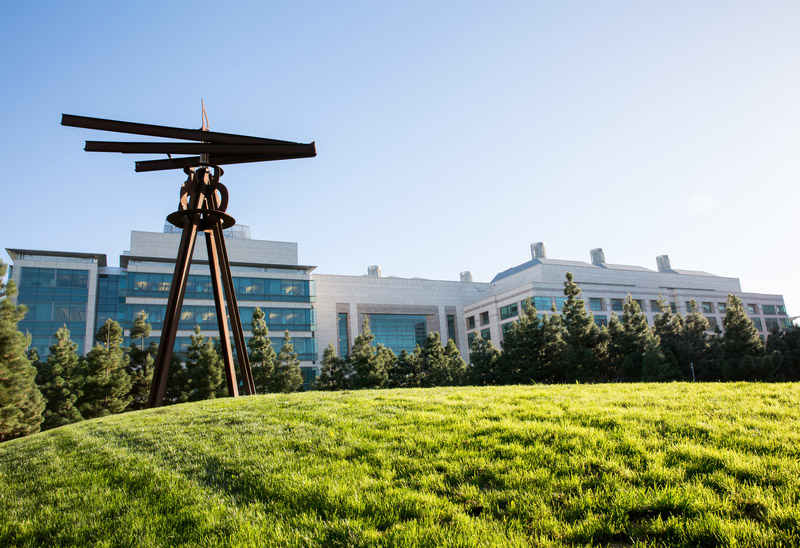
The "Dreamcatcher" sculpture by artist Mark di Suvero, located in Koret Quad.
In less than a decade, a number of remarkable facilities and programs have come together at UCSF Mission Bay, including:
- QB3, the California Institute for Quantitative Biosciences: A consortium of UC Berkeley, UC Santa Cruz and UCSF, QB3 is housed in Byers Hall, where the biotechnology industry comes together with academic research, spawning both new PhDs and new biotech startups.
- Genentech Hall: UCSF’s first facility at Mission Bay, this five-story building houses programs in structural and chemical biology as well as molecular, cellular and developmental biology. It also houses the Molecular Design Institute, Nikon Imaging Center and the Center for Advanced Technology.
- Arthur and Toni Rembe Rock Hall: The building is home to programs in human genetics, developmental biology, developmental neuroscience and the Center for Brain Development.
- Helen Diller Family Cancer Research Building: Scientists investigating cancer’s basic biological mechanisms, including brain tumors, as well as researchers in urologic oncology, pediatric oncology, cancer population sciences and computational biology, are based in the building.
- Orthopaedic Institute: The institute is a major center of outpatient treatment, research and training for musculoskeletal conditions, injuries and sports medicine. It is the first UCSF clinical service at Mission Bay.
- Smith Cardiovascular Research Building: The building is home to research scientists and clinicians who focus on achieving new understanding and treatment for heart and vascular diseases. It is headquarters for the legendary UCSF Cardiovascular Research Institute and houses the UCSF Center for Prevention of Heart and Vascular Disease, a world-renowned, research-driven prevention program serving outpatients.
- William J. Rutter Center: This four-story recreation and conference center serves both UCSF and the community, and includes a fitness complex, indoor and rooftop pools, a conference facility, activity center, pub and student services.
- Sandler Neurosciences Center: The five-story, 237,000 square foot building brings under one roof several of the world’s leading clinical and basic research programs focusing on neurological disorders, providing an environment that encourages a cross-pollination of ideas and collaboration. It houses the Institute for Neurodegenerative Diseases, Department of Neurology, W.M. Keck Foundation Center for Integrative Neuroscience, and the Memory and Aging Center.
- Mission Hall: Also known as the Global Health & Clinical Sciences Building, it officially opened in October 2014, housing some 1,500 professionals, pulling together all the faculty, staff and students working on global health, as well as the Office of the Chancellor.
The Mission Bay campus also includes housing for UCSF students, postdoctoral scholars, visiting faculty and their families, and a child care center.
Research
Innovation and discovery are the watchwords at UCSF’s Mission Bay campus, where industry and academia integrate in developing the therapies that promote the University’s mission of advancing health worldwide™.
In just a few years, many of UCSF’s most brilliant researchers set up shop in sparkling, new labs at UCSF Mission Bay, with state-of-the-art equipment making possible all sorts of new discoveries.
UCSF already boasts more than 1 million square feet of research space at Mission Bay, and many of its labs are establishing new models for how to work both with industry and with clinicians to discover new drugs, devices and cures. In a world where the pace of discovery seems to quicken by the day, the University’s Mission Bay facilities are providing the space, the technology and the collaborative environment to take advancement to warp speed.
The California Institute for Quantitative Biosciences, also known as QB3, a consortium of UCSF, UC Berkeley and UC Santa Cruz, based on the campus, emphasizes quantitative approaches to the biosciences as a means to develop the tools to predict biological processes. Through this approach, using sophisticated equipment, scientists work to predict exactly how a protein’s function will change if they alter its composition, how an organism will behave if a gene is modified and how patients will respond to a new therapy.
In other fields of endeavor, engineers build models to determine whether a circuit will work or how well an airplane will fly. At QB3, scientists emulate those models, hoping that by understanding the design principles of biology, they will be able to develop cells and microorganisms that provide unique resources such as drugs or biofuels.
QB3 scientists follow eight major research themes, from chemical biology to synthetic biology, and from harvesting the information in genomes to developing biomaterials and stem cells.
At the Helen Diller Family Cancer Research Building, research teams delve into three primary areas: laboratory research into the causes and events related to cancer’s progression; clinical research to translate new knowledge into viable treatments; and population research that can lead to prevention, early detection and quality-of-life improvement for those living with cancer.
The building is home to investigators from the Brain Tumor Research Center as well as those specializing in population sciences, pediatric oncology, urologic oncology and computational biology.
Bringing many of the researchers together — along with the innovative care at UCSF Medical Center at Mission Bay — creates myriad opportunities for new discoveries.
Putting basic scientists and clinicians together should ultimately lead to treatments and cures. “We can push the translational research envelope further than anywhere in the United States, bringing discovery faster to the patient,” says Peter Carroll, MD, MPH, associate dean of the UCSF School of Medicine and professor and chair of the Department of Urology. “We think it’s ideal.”
Academic-Industry Partnerships
The development of UCSF’s Mission Bay campus gave the University a rare opportunity to build space for the sort of partnerships that help drive top-notch research, innovation, education and patient care. At Mission Bay, UCSF boasts partnerships both with industry and with other academic institutions, all in the service of the University’s broader mission of advancing health worldwide™.
Industry was certainly ready to partner with UCSF. The University has a long history of working with biotechnology and pharmaceutical companies, dating to the birth of the biotech industry when UCSF research spawned Genentech in the 1970s.
Many innovative partnerships are already formed, thanks to the early successes of facilities such as the Clinical and Translational Science Institute and QB3, the California Institute for Quantitative Biosciences, as well as the arrival of pharmaceutical industry heavyweights such as Bayer, Celgene and Merck to the Mission Bay neighborhood.
But the partnerships are not merely between academia and industry. Sometimes the partners are research and academic organizations.
The Gladstone Institutes is an independent, nonprofit biomedical research foundation affiliated with UCSF and located adjacent to UCSF Mission Bay. Primary research efforts at the Gladstone Institutes focus on three of the most important clinical problems of modern times: cardiovascular disease, AIDS and neurodegenerative disorders. Gladstone researchers also hold faculty appointments at UCSF.
QB3, a consortium of UCSF, UC Berkeley and UC Santa Cruz, brings academics from various environments together to solve problems. “When scientists collaborate, they can extract greater value from their individual research programs at little additional cost,” says Regis B. Kelly, PhD, director of QB3 and former executive vice chancellor of UCSF.
What’s Located Here
California Institute for Quantitative Biosciences, QB3
QB3 is the University of California’s hub for innovation and entrepreneurship in life science. The institute supports UC researchers and empowers Bay Area entrepreneurs to launch startup companies and partner with industry.
Cardiovascular Research Institute (CVRI)
The Cardiovascular Research Institute performs cutting edge research illuminating cardiovascular and pulmonary biology and disease and trains clinicians and scientists to become future leaders of these fields.
Clinical & Translational Science Institute (CTSI)
The Clinical & Translational Science Institute (CTSI) facilitates clinical and translational research to improve patient and community health. CTSI provides infrastructure, services and training to enable research to be conducted more efficiently and effectively.
Gladstone Institutes
Based in San Francisco’s Mission Bay neighborhood, the Gladstone Institutes is an independent state-of-the-art biomedical research institution that empowers its world-class scientists to find new pathways to cures while maintaining a close academic affiliation with UCSF.
Graduate Division
The Graduate Division serves as the institutional home for graduate education and postdoctoral scholarship at UCSF, advocates for graduate students and postdocs, and promotes excellence in all graduate and postdoctoral training programs.
Helen Diller Family Cancer Research Building
The Helen Diller Family Cancer Research Building provides state-of-the-art facilities for scientists investigating cancer’s basic biological mechanisms, including brain tumors, urologic oncology, pediatric oncology, cancer population sciences, and computational biology.
Orthopaedic Institute
The Orthopaedic Institute offers world-class orthopedic care, using state-of-the-art equipment and technology to treat a wide range of musculoskeletal conditions.
Outpatient Services at UCSF Medical Center at Mission Bay
The UCSF Ron Conway Family Gateway Medical Building houses a variety of specialty outpatient services for women, children and cancer patients. The building is home to clinics ranging from dialysis to pelvic reconstructive surgery, pediatric oncology and cardiac care.
Sandler Neurosciences Center
The UCSF Sandler Neurosciences Center is a five-story, 237,000 square foot building that houses several of the world’s leading clinical and basic research programs. It supports UCSF’s efforts to find new diagnostics, treatments and cures for a number of intractable neurological disorders.
Sports Medicine Center
The UCSF Sports Medicine Center cares for athletes of all levels using a team of orthopedic surgeons, family medicine specialists, physical therapists and fitness experts to tailor treatment plans to each patient's needs.
Student Life
Student Life helps students get connected by collaborating with student groups and departments, offering support and providing guidance.
UCSF Bakar Cancer Hospital
The UCSF Bakar Cancer Hospital is part of the UCSF Helen Diller Family Comprehensive Cancer Center, and the only National Cancer Institute designated comprehensive cancer center in the Bay Area. Located steps away from a world-class research center, the new hospital brings top researchers and clinicians side by side, helping foster new treatments and speeding their delivery to patients.
UCSF Benioff Children's Hospital San Francisco
UCSF Benioff Children's Hospital San Francisco is home to advanced technology and world-class physicians. With more than 150 experts in 50 different specialties, it's designed from the ground up with kids in mind.
UCSF Betty Irene Moore Women's Hospital
The UCSF Betty Irene Moore Women's Hospital was designed to deliver cutting-edge care in a setting that supports the whole woman. Our scientists and clinicians have long been leaders in reproductive health and fertility, gynecological conditions, cancer and more.
UCSF Medical Center at Mission Bay
The UCSF Medical Center at Mission Bay is a state-of-the-art hospital complex that combines the latest technology with the highest standards of patient safety, energy efficiency, seismic readiness and environmental sustainability.
Resources
Bakar Fitness & Recreation Center at Mission Bay
The Bakar Fitness & Recreation Center features state-of-the-art equipment, a dedicated Pilates studio, an NBA full-sized gymnasium, two swimming pools, and a climbing wall.
Dining
Campus Planning Projects
777 Mariposa Street Acquisition
777 Mariposa will serve as a state-of-the-art cell therapy development, manufacturing and collaboration center operated by Thermo Fisher.
Parking Garage and Clinical Building at Block 34
A clinical facility and parking garage that will include an ambulatory surgery center, adult primary and secondary multi-specialty clinics, and a pharmacy.
Dogpatch Community Task Force
The Dogpatch Community Task Force was formed to identify and discuss potential impacts of UCSF’s proposed development in the Dogpatch neighborhood and to determine steps to help mitigate them. UCSF held a series of public meetings over eight months with the task force, composed of Dogpatch and Potrero Hill neighbors and merchants, city staff and UCSF.
Precision Cancer Medicine Building
The Precision Cancer Medicine Building, scheduled to open in summer 2019, will be a destination cancer treatment center for the region. This outpatient center will contain clinical space, chemotherapy infusion, radiology, radiation oncology, a patient resource center and support services.
Events
