
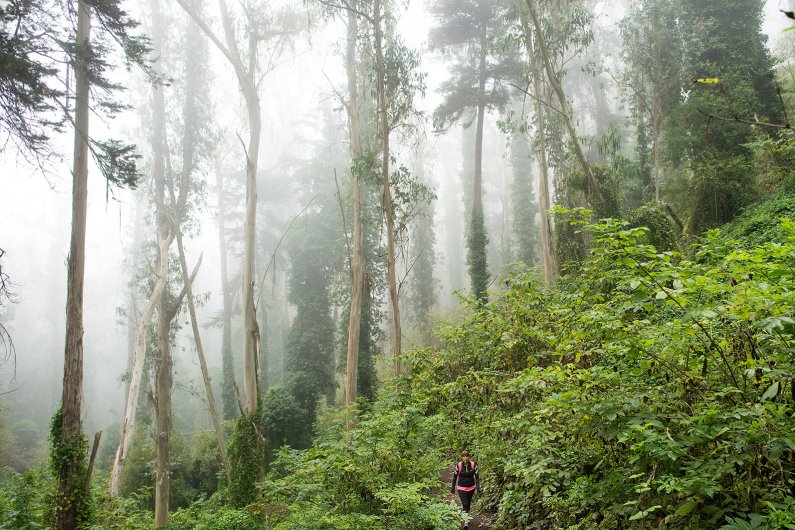
Mount Sutro Trails & Access Alert
Trail & Road Closures
Portions of the Mount Sutro Reserve multiuse trail system and access to Medical Center Way will be temporarily closed for maintenance work. This work addresses reduces fire and landslide risks for our Reserve trails and roadways.
Please expect limited access throughout the duration of the project.
What to Expect
Medical Center Way (90 Medical center Way to Jonhstone Drive) will be closed to pedestrian, bicycles, and vehicles during operations.
Historic, Fairy Gate, and Edgewood trails will be closed to pedestrians and bicyclists during operations.
Nike Road will be closed to pedestrian and bicycle.
Use Quarry Trail as the detour route to access the Historic trail or Summit.
Shuttle Service
The Bronze Shuttle will be rerouted and will not operate along Medical Center Way during this period.
About the Reserve
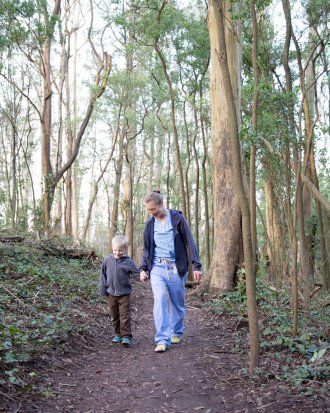
Photo by Susan Merrell
This urban oasis – neighboring UCSF’s Parnassus Heights campus, residential homes and the iconic Sutro Tower – includes the UCSF Chancellor's Residence and the Aldea San Miguel Campus Housing and Conference Center. The Reserve also features more than 5 miles of public, multi-use trails, with a 900-foot elevation gain, that cater year-round to hikers, trail runners, dogs on leash and cyclists.
Steeped in San Francisco History
Named for its former owner and San Francisco Mayor Adolph Sutro, the Reserve has a history of transition much like many San Francisco neighborhoods.
A successful engineer and real estate investor, Adolph Sutro served as San Francisco mayor from 1894 to 1896. Sutro’s many land holdings included Mount Parnassus, which was renamed Mount Sutro in his honor.

Adolph Sutro was mayor of San Francisco from 1895 to 1897. Image courtesy of the U.S. Library of Congress
In 1886, Sutro began planting the hill with imported and native trees to celebrate San Francisco’s first Arbor Day.
Sutro donated 13 acres of land on Parnassus Avenue to the UCSF Regents in 1895 for development into the UCSF Parnassus Heights campus.
Sutro’s death in 1898 led to years of legal battles among his heirs, culminating in 1909 with a deal between the Sutro estate and Consolidated Eucalyptus Company to log and process trees across more than 1,500 acres on Mount Sutro. The logging operation closed in 1934 after a 10-acre fire turned neighbors against the lumber mill. During the Cold War, Mount Sutro was home to a Nike missile site.
In 1953, UCSF purchased a 90-acre parcel to the south of the original parcel donated by Sutro, and most of that is now the Mount Sutro Open Space Reserve. In 1976, UCSF designated 58 acres of the Reserve as permanent open space and subsequently increased the size to 61 acres. The area designated as the Mount Sutro Open Space Reserve shall be kept free of any permanent structures or facilities except footpaths and appropriate landscape construction intended to enhance its use as a natural area.
UCSF’s Commitment
UCSF is committed to maintaining the Reserve as an important natural resource for San Franciscans and takes seriously its responsibility to keep the site safe and accessible.
To preserve the beauty, safety and accessibility of Mount Sutro, UCSF Facilities Services performs ongoing general maintenance throughout the Reserve and its trails. UCSF has two certified arborists on staff who are dedicated to preserving the beauty of the natural environment.
Ongoing general maintenance of the Mount Sutro Summit, trails, roadways and areas adjacent to structures and neighboring homes includes:
- Removal of storm debris, downed trees or branches, hazardous trees, broom, trash, and campsites
- Management of overgrown vegetation
- Bi-annual removal of invasive sprouts
- Scheduled tree pruning
- Drain clearing
- Security patrol
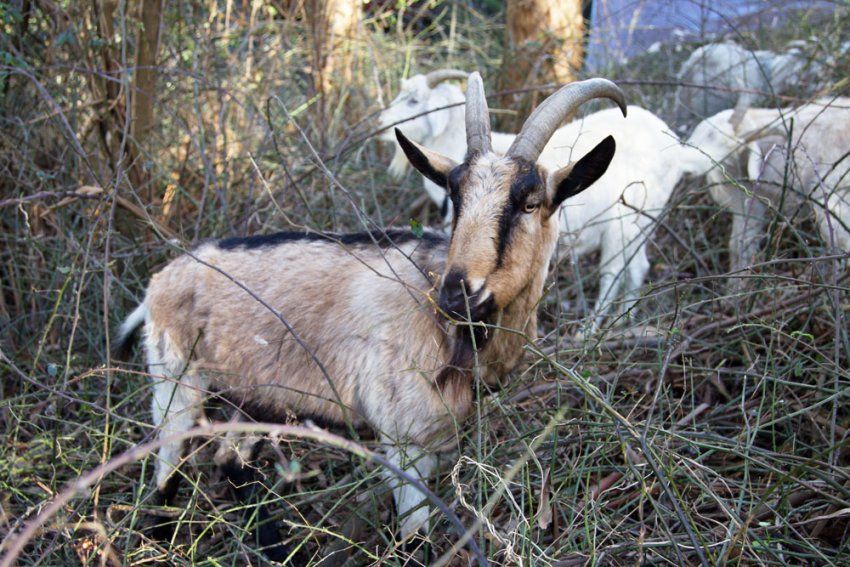
UCSF brings in goat herds to help control vegetation growth on Mount Sutro. Photo by Susan Merrell
In line with our commitment to a healthy and sustainable Reserve, we discontinued the use of herbicides in 2008. All work is performed using hand and mechanical tools or goats to control vegetation growth.
Our regular maintenance is independent of the Reserve management plan that is currently being developed and the fire mitigation and hazardous tree removal projects performed as necessary to respond to potentially dangerous conditions in the Reserve.
Visit or Volunteer
Visit
Visitors will enjoy an abundance of rare and native plants, as well as many species of trees including Monterey Pine, Monterey Cyprus and Blue Gum Eucalyptus. At the summit of Mount Sutro is Rotary Meadow, our native plant garden and demonstration area.
There are no public parking areas on Mount Sutro, so we encourage our visitors to take public transportation or to park on Clarendon Avenue.
Public Transportation: Take the #6 or #43 Muni bus lines to Parnassus Avenue (Willard stop). Walk along Medical Center Way and walk up the stairs to the trailhead.
Street Parking: Park on Clarendon Avenue near Johnstone Drive. Walk past the Aldea Center along Johnstone Drive to reach the trailhead.
Community Partners
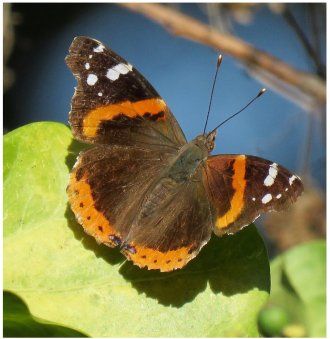
A Red Admiral butterfly, common at the reserve. Photo by Liam O'Brien
Golden Gate Bird Alliance
UCSF has worked with the Golden Gate Bird Alliance to monitor the impact on bird and butterfly life in the Reserve. Starting in 2019, they observed 47 bird species and observed 56 species in 2020. Butterfly monitoring began in 2020, during which 20 species of butterflies were observed.
We encourage you to read more about the Golden Gate Bird Alliance’s findings from 2019 and from 2020.
Sutro Stewards
Founded in 2006 by Craig Dawson, a native San Franciscan, Dawson has been active as an advocate for protecting and preserving Mount Sutro since he joined UCSF’s Community Advisory Group in 1992.
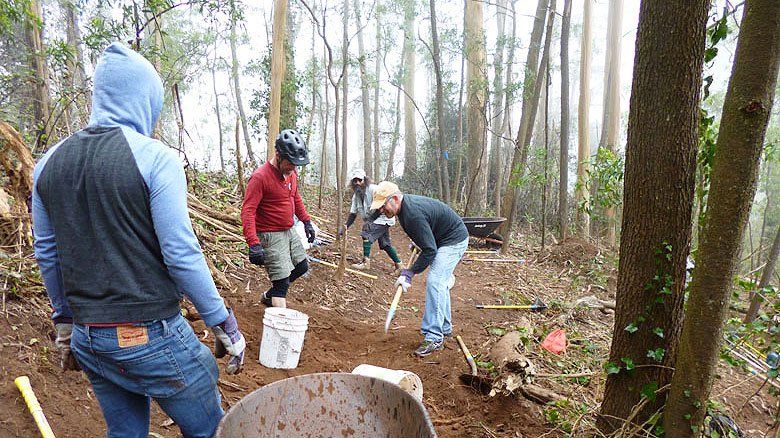
Sutro Stewards volunteers helping to maintain a trail on Mount Sutro. Photo courtesy of Sutro Stewards
The Sutro Stewards work in collaboration with UCSF to maintain and manage the 5.5. miles of multi-use trails, habitat restoration and conservation sites, and on-site native plant nursery on 61 acres of Mount Sutro.
Current Sutro Stewards Activities
Rotary Meadow: The Mount Sutro summit is home to Rotary Meadow where the Stewards have installed 338 plants representing 19 different species from native coastal scrub and coastal prairie plant communities.
Clarendon Trail: In partnership with UCSF, the Sutro Stewards are actively building a new trailhead and improving the Clarendon Trail on the southwestern side of Mount Sutro, which is part of the larger Bay Area Ridge Trail in San Francisco.
If you’re interested in working on these, or other stewardship opportunities on Mount Sutro, volunteer with the Sutro Stewards.
Vegetation Management Plan
UC San Francisco’s top priority is to ensure the safety of the Reserve for our residents, patients, visitors, campus buildings and neighboring homes. Over the last decade, droughts across California have caused widespread decline in the overall health of trees. This decline is also evident in the Reserve.
In response, UCSF began a process in 2015 to develop a management plan to ensure the long-term health and sustainability of the Reserve. The Mount Sutro Vegetation Management Plan was approved in April 2018, which identifies three phases of forest treatment over the next 20 years to address the declining health of the forest. Implementation of the Vegetation Management Plan began that fall.
Implementation
On September 29, 2021 UCSF hosted a community meeting to provide an overview of upcoming work for Fall 2021- Winter 2022. The Sutro Stewards also shared information about their recent work on Mount Sutro and how it supports the goals of the Vegetation Management Plan.
Phase 1, 1 to 5 years: Forest treatments focus on the areas in greatest need including:
- removing dead, dying, unhealthy and structurally unsound trees along roads, trails, and structures,
- controlling invasive low-growing vines and shrubs that would compete with desired vegetation,
- preventing sprouts from decayed stumps (these sprouts would also contain decay), and
- planting new trees.
The first phase initiates forest treatments to establish a new generation of trees in the Reserve, including individual tree selection and seed tree treatment methods in limited locations. It also re-establishes defensible spaces for fire mitigation purposes and reduction of fire loads by using goats, instead of using herbicides.
The second and third phases will target additional areas of decline by clearing out dead and dying trees and replanting both trees and other vegetation in those areas.
UCSF is replanting a mixture of eucalyptus to restore the eucalyptus groves and native trees, along with other native plant species to improve biodiversity and ecosystem health. Since implementation of the plan, we have already replanted over 1,100 trees to regenerate the tree canopy.
Year One
East Ridge, Farnsworth Trail, Clarendon Trail, and Woodland Canyon.
Year Two
Christopher Drive, Crestmont Drive, and the area between Nike Road and the summit.
Year Three
Crestmont and Christopher Drive, Medical Center Way, and Fairy Gates Trail near Clarendon Avenue.
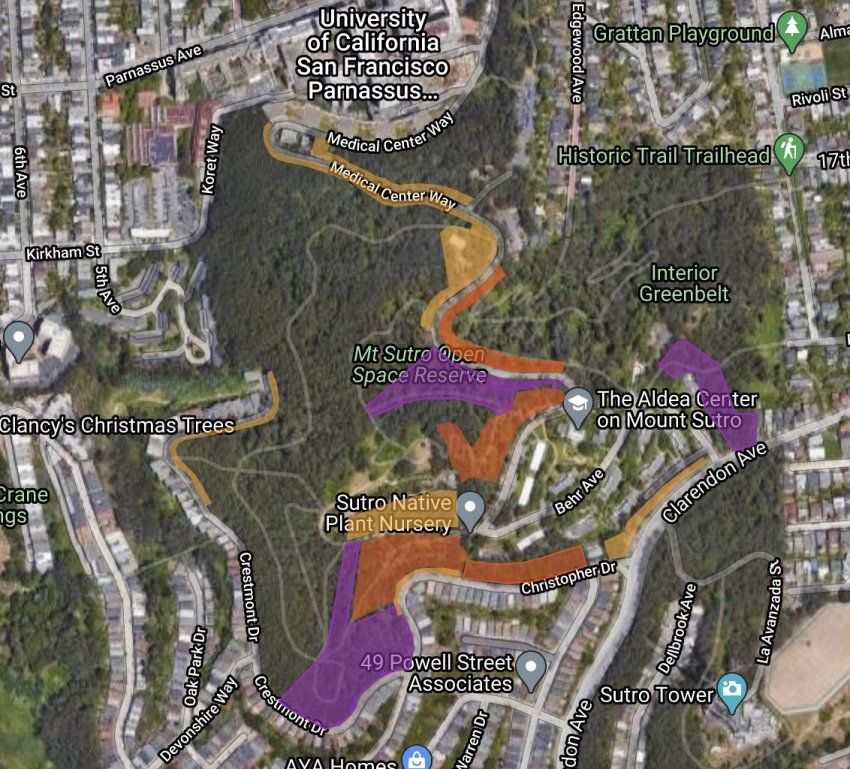
Phase 2, 6 to 10 years: Continue removing dead and dying trees across all forest types with individual tree selection, establish seed tree treatment, and begin group selection in all forest types. Continue planting a mixture of eucalyptus and native trees in all forest types.
Phase 3, 11+ years: Treat with a mix of seed tree treatment, and group selection in all forest types, continue planting mixture of eucalyptus and native trees in all forest types, and continue to remove dead and dying trees in all forest types.
Creation of the Plan
In 2015, UCSF recognized that several years of drought, disease, and the age of the Mount Sutro’s stand of trees had led to a decline in the overall health of the forest. Overall, there were too many trees in the Reserve to support a healthy canopy. Under ideal conditions, the forest should have many more small-diameter trees than large-diameter. At that time, it was true in only a third of the Reserve, but a large proportion of those trees are either dead or in poor health.
There also was abundant evidence to suggest that the existing forest would not recover on its own, with data showing a continuing trend of declining tree health.
Public Process
To develop the proposed vegetation management plan for the Reserve, UCSF led an extensive public process involving expert, community, and environmental review and revisions. The public process included a Technical Advisory Committee (TAC) comprised of local experts in forestry, hazard reduction, biology, and habitat restoration to provide guidance on best practices in forest management. UCSF held four TAC meetings, which were open to the public, followed by two community meetings and public tours of the Reserve, giving the public many opportunities to help shape the final plan, discuss their concerns and provide feedback.
This was followed by the launch of the environmental review process. UCSF held a scoping meeting in February 2017, followed by a public hearing on the Draft Environmental Impact Report in August 2017. During the extended public comment period, UCSF received and responded to more than 340 public comments. This interactive process ensured that the final plan incorporates not only the experts’ guidance, but also reflects community feedback.
Visit the Community Process Archives
Environmental Review Process
As required by the California Environmental Quality Act (CEQA), the Environmental Impact Report (1) assessed the potentially significant environmental effects of the proposed project, including cumulative impacts of the proposed project in conjunction with past, present, and reasonably foreseeable future development; (2) identified feasible means of avoiding or substantially lessening significant adverse impacts; and (3) evaluates a range of reasonable alternatives to the proposed project, including the No Project alternative.
Read the Final Environmental Impact Report
Final Management Plan
The 20-year Management Plan addresses the short-term and long-term management of the Reserve to achieve its goals to protect the safety of residents and visitors, improve ecosystem health, regenerate the forest, and maintain and ensure public access to the Reserve. As a result of the extensive public review process, the environmental review determined that small variations of the original draft plan would mitigate some potential impacts and improve the health of the forest. These variations were outlined in Alternative 4, one of the alternatives studied in the EIR. Alternative 4’s variations included a change to the tree planting species mix in the first phase (five years) of the plan, from replanting only eucalyptus trees to a planting mix of 75% eucalyptus and 25% native species. Also, tree replanting areas will be smaller than in the original plan and located further from trails to lessen visual impacts and improve the overall experience for visitors to the Reserve.
The final plan adopts Alternative 4 as the project. It was approved by UCSF’s Chancellor on April 30, 2018.
Support for the Plan
UCSF’s proposal to manage the Mount Sutro Open Space Reserve is supported by many neighbors, open space advocates and community and environmental groups, including:
- California Native Plant Society
- Inner Sunset Park Neighbors
- Nature Conservancy
- Rotary Club of San Francisco
- San Francisco Department of the Environment
- San Francisco Urban Riders
- Sierra Club
- Sutro Stewards
Sierra Club
“After a thoughtful and interactive process with experts and the community, UCSF has developed a much-needed plan to restore the health of the Mount Sutro Open Space Reserve.”
Sutro Stewards
“As an organization that works with dedicated volunteers every week to maintain and improve Mount Sutro, we are personally invested in the health and longevity of the Reserve. We see firsthand the need to manage the open space for long-term sustainability, and we support UCSF's plan to regenerate the Reserve to a healthy, diverse ecosystem for all to enjoy.”
Peter Brastow
Senior Environmental Specialist, Biodiversity, San Francisco Department of the Environment
“In large part, the City’s Department of the Environment implements the sustainability vision for the City and County of San Francisco, including promoting local biodiversity, the conservation of our natural heritage and equitable access and experience of nature in the city. We were very pleased to participate in the Technical Advisory Committee, and we support the overall vision of the Vegetation Management Plan.”
Inner Sunset Park Neighbors Board
“We are pleased to support UCSF’s Mount Sutro plan because of the extensive outreach and community support it has received. Inner Sunset neighbors frequently visit the Mount Sutro Open Space with their families to enjoy a respite from their busy urban lives, and the effects of the drought have become far more apparent during the past few years. We support the proposals to improve the conditions and safety of the Reserve so that it remains exceptional sanctuary we all know and love for generations to come.”
Louis Blumberg
California Climate Change Director, The Nature Conservancy
“The ecological health of the Sutro Forest is declining rapidly and significant intervention is needed, quickly, to fulfill the vision of the plan and protect San Francisco’s natural heritage for this and future generations. We urge quick action – to approve the EIR, the Plan and to get to work."
Technical Advisory Committee
California’s severe, ongoing drought has led to widespread decline in the overall health of the Reserve, a serious problem facing all forests and open space areas across the state.
UCSF formed a Technical Advisory Committee (TAC) to discuss our Mount Sutro Open Space Reserve Management Plan. In developing this plan, the University staff worked with consultants and a Technical Advisory Committee (“TAC”) comprised of experts with extensive experience in forestry, hazard reduction, biology and habitat restoration. All members are volunteered their time to assist in this important process. TAC members provided guidance on the scope, techniques and best practices for the management plan. TAC members included:
- Peter Brastow, Biodiversity Coordinator, San Francisco Department of the Environment
- Peter Erlich, Forester, Presidio Trust
- Joe McBride, Professor Emeritus of Landscape Architecture and Environmental Planning, University of California Berkeley
- Lew Stringer, Restoration Ecologist, Presidio Trust
- Richard Sampson, Forester/Division Chief, CAL FIRE[EA2]