
- Message from the Chancellor
- LRDP Process and Community Participation
- 2014 LRDP
- 2014 LRDP Environmental Impact Report
- Previous LRDPs
- Background Reports
Message from the Chancellor
Dear Neighbors,

It is with pride and gratitude that I present UCSF’s 2014 Long Range Development Plan (LRDP), which was approved by the UC Board of Regents on November 20, 2014 along with its accompanying Environmental Impact Report.
This plan represents five years of planning and consultation with the City and the community. The plan was steered by a UCSF Oversight Committee comprised of a cross-section of administrators, faculty and staff, working in close collaboration with neighbors living near UCSF campus sites.
We are extremely thankful for the input and thoughtful ideas provided by so many of our neighbors, who took the time and effort to participate in this process. We recognize our future is directly tied to that of our neighbors and surrounding communities, and the importance of being inclusive, flexible and receptive to the input of ideas from our fellow San Franciscans.
We now look forward to implementing the LRDP and continuing our goals of providing our patients with the highest quality care, training the next generation of medical professionals, and finding new discoveries that will help save lives around the globe.
Sincerely,
Sam Hawgood, MBBS
Chancellor
LRDP Process and Community Participation
The 2014 LRDP reflects the culmination of five years of planning, including extensive consultation both within UCSF and with UCSF’s neighbors. The 2014 LRDP was prepared under the guidance of UCSF’s LRDP Oversight Committee, convened by the Chancellor to provide recommendations regarding UCSF’s physical development. See the membership of the LRDP Oversight Committee and its three subcommittees in the areas of instruction, research, and clinical facilities planning.
In addition, UCSF worked in collaboration with the community through its Community Advisory Group (CAG), which was founded in 1992 to provide guidance on the 1996 LRDP and continues to serve as the backbone of the community process. Visit the CAG page for information about the CAG’s mission and meetings.
In preparing the LRDP, UCSF explored in detail a variety of potential projects for each campus site, which were discussed at seven community workshops held at the Parnassus Heights, Mission Bay, Mount Zion, and Mission Center neighborhoods beginning in the fall of 2012. Feedback received at those workshops is reflected in the LRDP. UCSF published a draft of the LRDP in May 2014, and presented it at two public community meetings at Mission Bay and Parnassus Heights in June 2014.
Click here for LRDP meeting agendas and presentations.
A Draft Environmental Impact Report (EIR) on the LRDP was prepared in accordance with the California Environmental Quality Act (CEQA) and published on August 15, 2014. Following a 60-day public review period from August 15, 2014 through October 14, 2014, which included a public hearing on September 22, 2014, UCSF prepared the Final EIR.
The Board of Regents of the University of California certified the Final EIR and approved the 2014 LRDP at their November 2014 meeting. Click here to view the Final EIR and Final LRDP.
UCSF thanks the many members of the community who provided comment on the Draft LRDP and Draft EIR, and/or attended one or more of the seven community workshops, two informational meetings, CAG meetings, and the Aldea Housing meeting, for your participation in the LRDP planning process. Your feedback helped shape many of the proposals presented in the Final 2014 LRDP.
2014 LRDP
The 2014 LRDP is a comprehensive physical land use plan intended to guide UCSF’s growth and other physical changes through the year 2035, applying specific strategies to achieve the academic, clinical, and research missions of the University.
The 2014 LRDP is guided by five objectives:
- Respond to the City and community context;
- Accommodate UCSF’s growth through 2035;
- Ensure UCSF’s facilities are seismically safe;
- Promote environmental sustainability; and
- Minimize facility costs.
The LRDP estimates overall growth in UCSF’s square footage and population through 2035, and provides guidance for the siting of individual projects in the future.
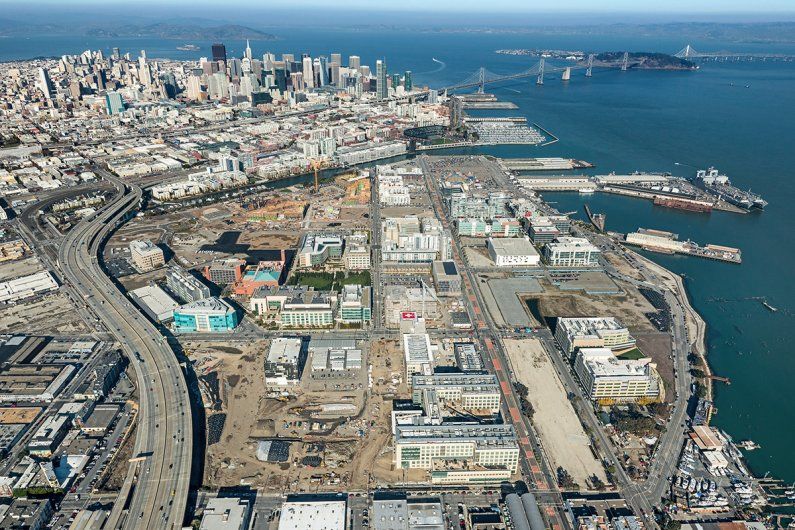
The 2014 LRDP, if fully implemented over the next 20 years, would result in an additional 2.39 million gross square feet (gsf) in owned and leased buildings, for a total of 11.56 million gsf across all of UCSF’s sites. The LRDP proposes to accommodate most of this growth in new buildings at UCSF’s Mission Bay campus site, where there is undeveloped land available and infrastructure planned to support such growth. Additional space in new buildings is proposed at UCSF’s Parnassus Heights, Mount Zion, and Mission Center campus sites. LRDP proposals for the Parnassus Heights campus site also advance UCSF’s work toward compliance with the 3.55-million-gsf space ceiling imposed by the Regents to limit growth there, as well as compliance with state seismic laws for inpatient facilities through the long-range plan to decommission Moffitt Hospital as an inpatient facility and the construction of an addition to Long Hospital by 2030. During the horizon of the LRDP, UCSF is also considering reducing the number of its overall sites, both leased and owned, in an effort to improve operational efficiency, collaboration, and programmatic flexibility, and to reduce the cost of reinvestment.
2014 LRDP Environmental Impact Report
A Draft EIR on the LRDP was prepared in accordance with the California Environmental Quality Act (CEQA) and published on August 15, 2014. The EIR provides a program-level analysis of the proposed 2014 LRDP, as well as project-level analysis for a number of specific 2014 LRDP development proposals where greater project detail was available.
Following a 60-day public review period on the Draft EIR from August 15, 2014 through October 14, 2014, which included a public hearing held on September 22, 2014, UCSF prepared the Final EIR.
The Board of Regents of the University of California certified the Final EIR at their November 2014 meeting.
Previous LRDPs
The Regents require each campus in the University of California system to evaluate its academic and physical plan for future development. This plan, a Long Range Development Plan (LRDP), guides physical development over the plan’s timeframe.
The 1996 LRDP described plans for UCSF’s physical facilities through the 2011-2012 academic year and involved two major components - reinvesting in existing sites, including carrying out necessary infrastructure, code and seismic improvements; and establishing a major new campus site to provide 2.65 million gross square feet of new space for biomedical research and associated support facilities. In 1997, Mission Bay was selected as the location of the major new campus site. The 1996 LRDP was amended three times - to allow for the development of housing at the Mission Bay campus site, articulate a new clinical configuration for UCSF involving major inpatient sites at Parnassus Heights and Mission Bay with a major outpatient hub at Mount Zion, and adopt Mission Bay Planning Principles to guide off-campus development in the vicinity of the Mission Bay site in response to community concerns about UCSF’s expansion there.
UCSF’s 1982 LRDP called for the dispersal of UCSF’s functions away from Parnassus Heights in order to accommodate growth. Under the 1982 LRDP’s strategy of decentralization, UCSF purchased and leased a number of satellite facilities including Laurel Heights, the Mission Center building, and clinical facilities at Mount Zion. Inefficiencies resulting from the ensuing scattered operations led to the recommendation in the 1996 LRDP to consolidate further growth at a single major new site, which is now located at Mission Bay.
UCSF’s 1976 LRDP contained policies to limit growth at the Parnassus Heights campus site due to concerns over the density of proposed development there, and resulted in the 1976 Regents' Resolution to limit development at Parnassus Heights to 3.55 million gross square feet, which is now often referred to as the Parnassus Heights “space ceiling.”
Background Reports
UCSF Strategic Plan
The UCSF Strategic Plan articulates the investments the University must make — in people, infrastructure, facilities, partnerships and working environment — to achieve its goals.
Physical Design Framework
The Physical Design Framework is a companion document to the LRDP which provides clear and consistent planning and design principles to guide the development of physical facilities at all UCSF sites. The Physical Design Framework will be updated as needed to be consistent with UCSF's next LRDP.
Download the Physical Design Framework
Capital Financial Plan
The Capital Financial Plan is a 10-year plan that describes UCSF’s planned capital investments over the coming decade. The Capital Financial Plan is updated annually.
Download the Capital Financial Plan
Mission Bay Phase 2 Planning Study
Since construction began in 1999, UCSF Mission Bay has bloomed into a vibrant campus with research buildings, a community center, a student housing complex, parking facilities and major landscaped open space areas. Additional land has been acquired to the south of the original campus where a 289-bed hospital complex featuring three separate hospitals is now under construction. The Mission Bay Phase 2 Planning Study examines options for how the remaining undeveloped blocks on the original campus site could be developed. The preferred option will be identified in UCSF’s next LRDP.
Download the Mission Bay Phase 2 Planning Study
Economic Impact Report
UCSF is a major economic engine for San Francisco and the Bay Area. UCSF’s 2010 Economic Impact Report describes the direct and indirect economic growth generated by UCSF’s $3.3 billion enterprise, its 21,900 employees and the world-class research, patient care and education they support, which together generates a $6.2 billion impact on industry output in the Bay Area.
Download the Economic Impact Report
Related Links
LRDP News
- UC Regents Approve UCSF’s Long Range Development Plan for 2035, November 21, 2014
- UCSF Releases Physical Plan for 2035, May 23, 2014
- UCSF Set to Launch New Long Range Development Plan, October 10, 2012
- UCSF Begins Long-Range Planning About its Future Through to 2030, October 14, 2011
Community & Government Relations Projects
UCSF is engaged in a variety of ongoing projects designed to enhance the campus and medical center, and better serve both patients and the greater community.
When we embark on any project, planning always includes engagement with the local community.